
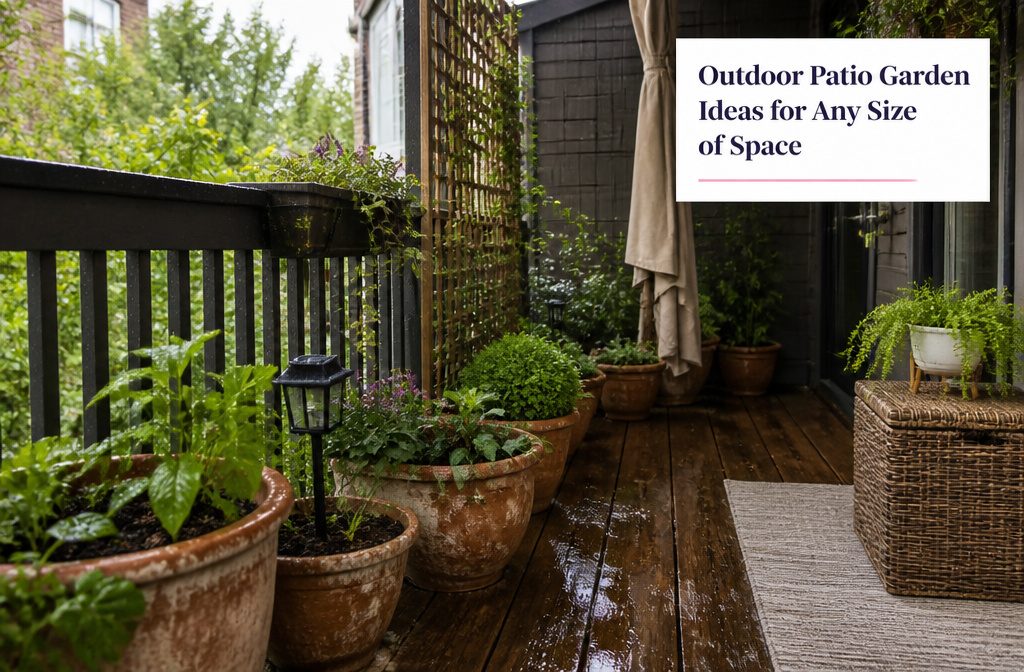
The ideas run from a $0 rearrangement of pots to a fire table or a pergola, and the deciding rule is whether you rent.
Anything that lifts off when the lease ends wins: pots, freestanding trellises, solar lamps, a shade sail. Fire features and covers need a clearance check first, since the manufacturer’s manual sets the distance to walls and railings.
1. Container and Potted Gardens
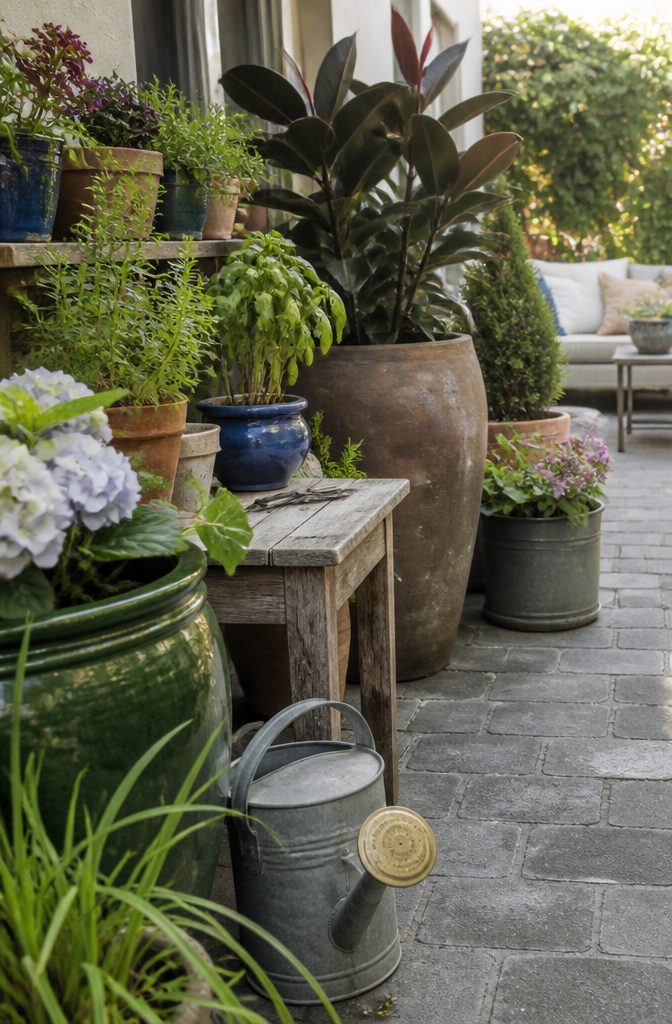
Pots are the one patio garden you can take with you, which makes them the renter’s pick.
Flowers, herbs, and vegetables all grow in containers, and each pot can have its own soil, water schedule, and light, so a thirsty basil doesn’t have to share with a drought-tolerant evergreen.
Mix materials on purpose: ceramic for a glazed color note, terracotta for warmth, metal for an edge.
Large pots set along the patio’s edges define the space, while smaller ones sit on tables and shelves. Stack or tier them to use height as well as floor.
For an anchor, a rubber plant or fiddle leaf fig in a supersized container works best in a sheltered spot with the right light. Pair evergreens with seasonal blooms and the patio stays green all year.
2. Raised Beds and Vegetable Gardens
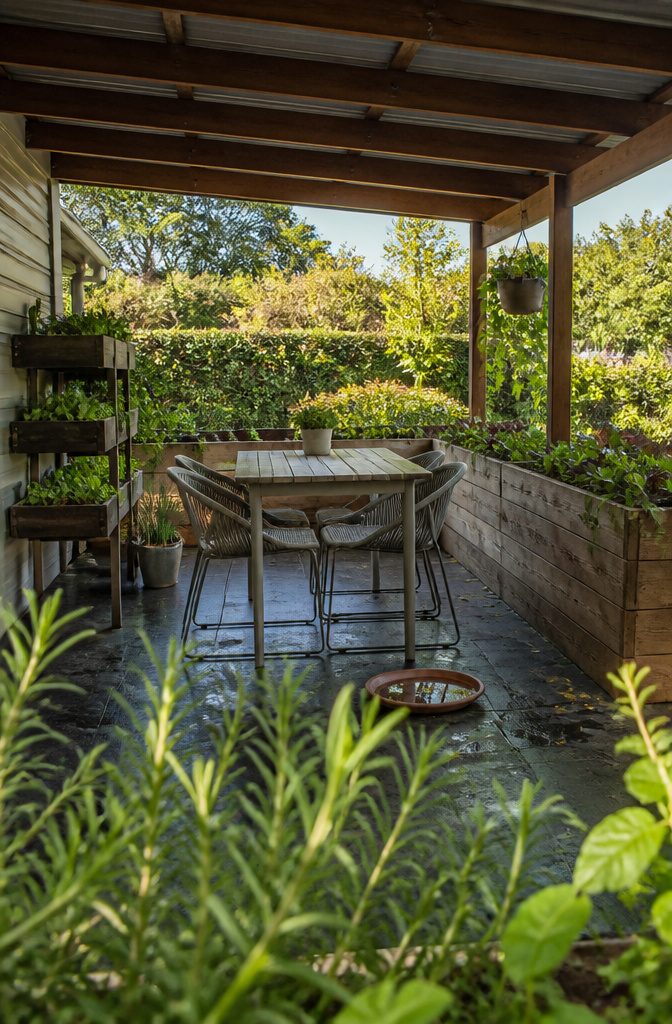
Raised beds along the edge of a patio do two jobs: they grow food and they frame the space with greenery, so the paved area reads as a room instead of a slab.
Run them down the perimeter and leave the middle open for a table or chairs.
Where floor space is tight, go up. Tiered or vertical planters stack several plants on one small footprint, which is how a balcony-size patio can still hold herbs and salad greens.
I’d choose a tiered stand over a second bed for anything under a couple of chairs wide.
A covered patio works for vegetables too. The roof keeps you comfortable while you tend things, and the bed itself becomes part of the seating view, so plant it as carefully as you’d arrange a sofa.
Its limit is light: check how much sun reaches under the cover before you commit.
3. Vertical Gardens and Climbers
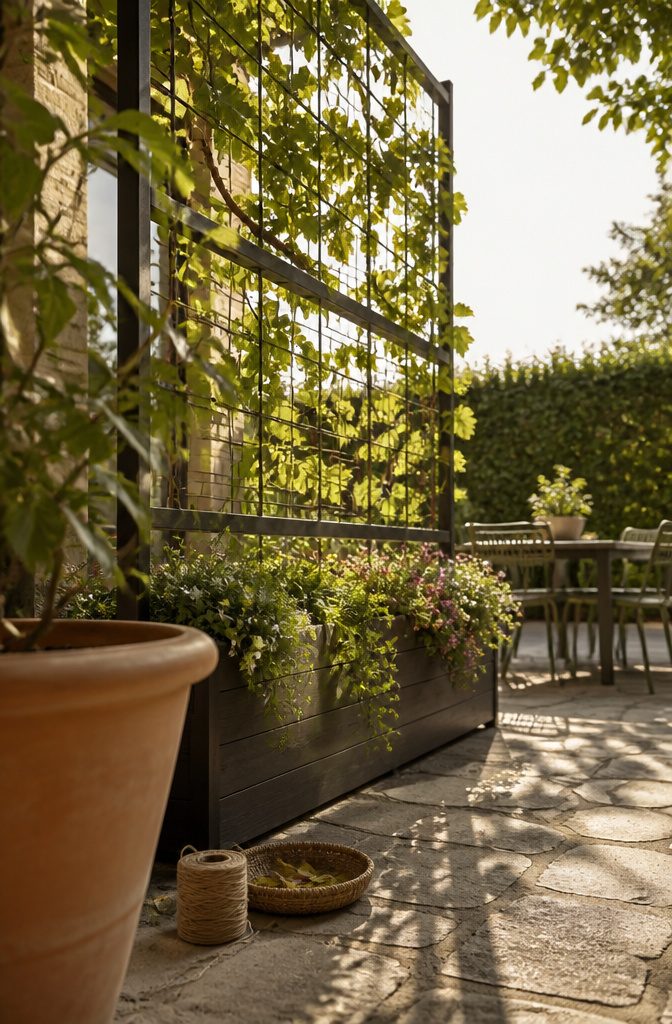
Height is the cheapest square footage a patio has.
A wall-mounted trellis or a pocket planter panel adds growing space without costing a single inch of floor, and for renters, freestanding trellises in a heavy pot beat anything screwed into siding.
For a pergola, wisteria gives the best shade and the heaviest bloom, but it is a muscular vine that needs strong posts and yearly pruning.
Grape vines are my pick for a dining patio: the leaves cool the space in summer and the fruit is a bonus. Climbing roses suit a trellis against a wall, tied loosely to the frame as they grow.
Train vines on wire or lattice before they reach the top, because a tangled one is hard to fix later. Window boxes and rail planters finish the look with trailing color at eye level.
4. A Small, Private Patio Nook
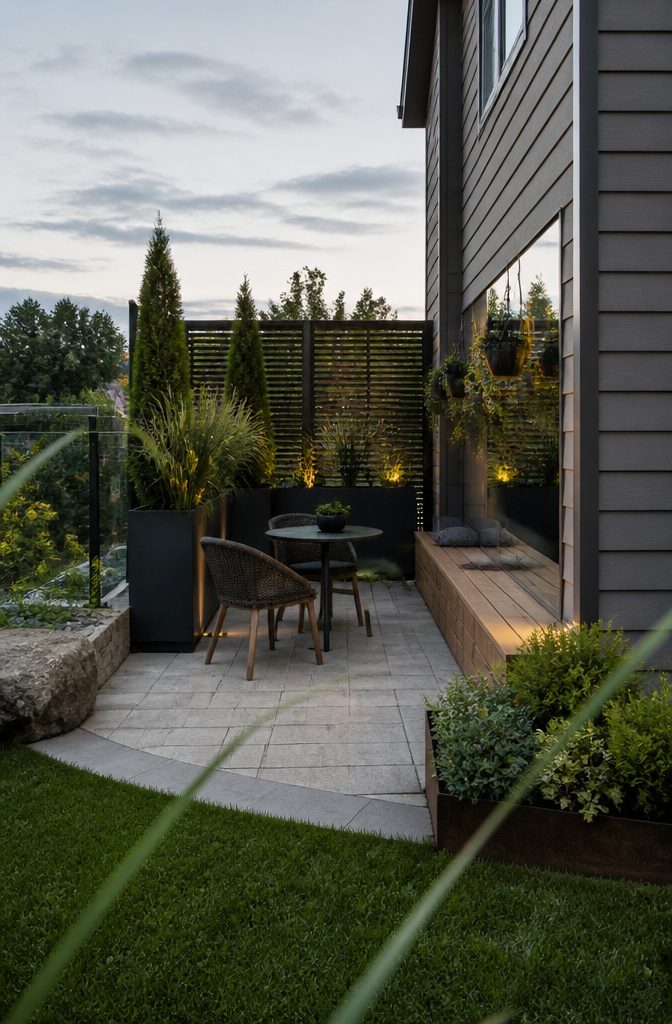
Slim, tall plants do the most work in a small nook.
Bamboo or evergreens along one edge soften neighborhood noise and make a protected corner, and ornamental grasses give you low-maintenance color while marking where the "room" ends. Trellises, tall planters, and privacy screens define the space without eating floor area.
Mirrors come next. Put a feature wall on one side and a mirror on the other, then hang baskets or planters in front so the reflection looks like more garden.
Teak flooring, glass fencing, and a bistro-style window cost real money, so I’d add them only after the basics are in.
Compact chairs and a built-in bench with storage keep the floor clear, and I’d pick that bench over a loose chest every time.
5. Covered Patio or Pergola
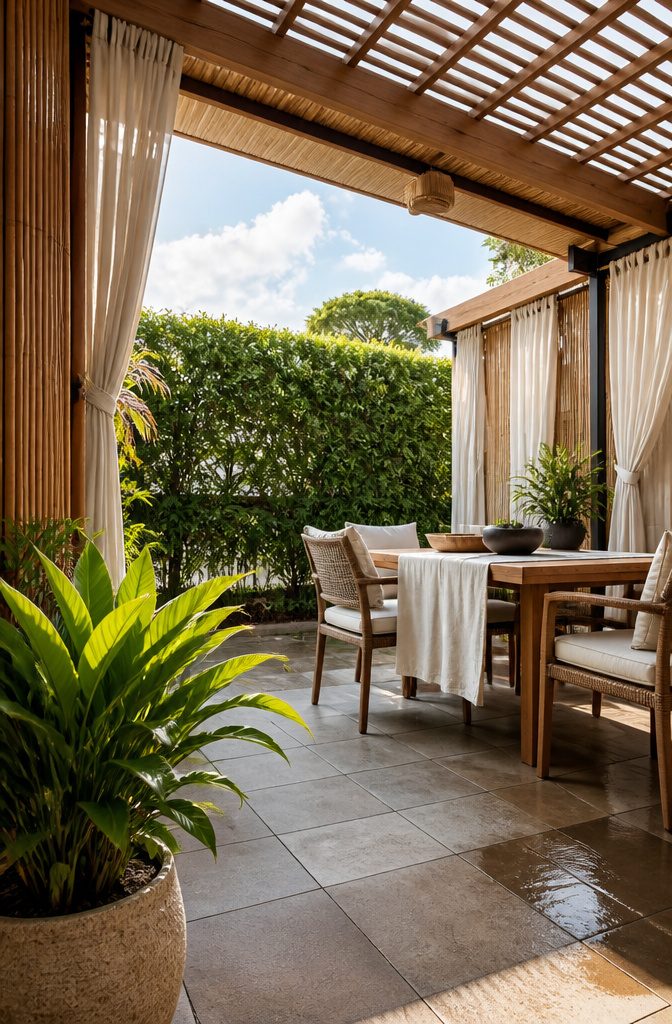
A cover turns a slab into a room, and the six options split by how much shelter and how much permanence you want.
A pergola frames a dining area and lets dappled light through, so it suits anyone who still wants some sun.
A half-pergola covers only one side. A shade sail protects a compact urban patio and is the easiest of the six for a renter to hang.
A wall-mounted canopy and a trellis-like roof sit between those two. A covered loggia is real construction, so I’d leave it for owners.
For looks, bamboo reads tropical, and a few touches of black paint give it a modern edge. Outdoor fabric and draperies make the space feel enclosed, and a cover also protects furniture and cuts mold and mildew on cushions.
6. An Outdoor Living Room
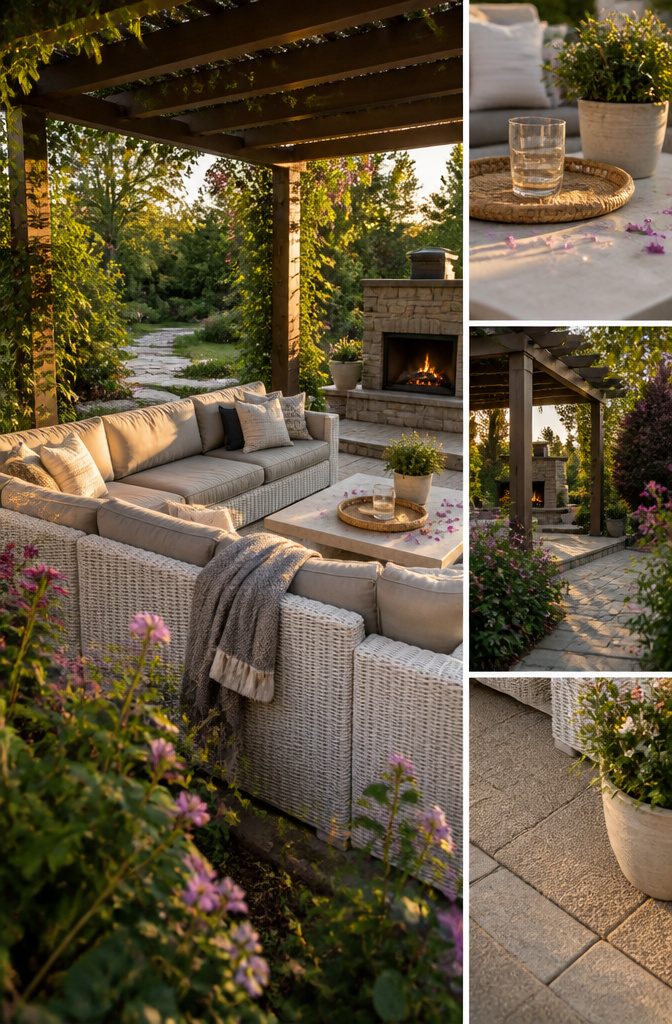
A sprawling corner sofa under a pergola, a coffee table, plush cushions and a fireplace are what make a patio read as a room instead of a place to park chairs.
Start with the sofa, since it sets the footprint, then add a low table within arm’s reach.
White wicker leans cottage and airy, while wrought iron looks more formal and sits well on natural stone, travertine or porcelain pavers.
For a renter, I’d pick wicker: it’s lighter to move. Either way, choose weatherproof fabric such as Sunbrella or Janus et Cie for the cushions, so they stay on the sofa through the season.
A rug made from accent pavers marks the seating zone without fabric to haul inside. Add a fireplace only if your municipality and layout allow it, and keep the clearances.
7. Outdoor Dining Area
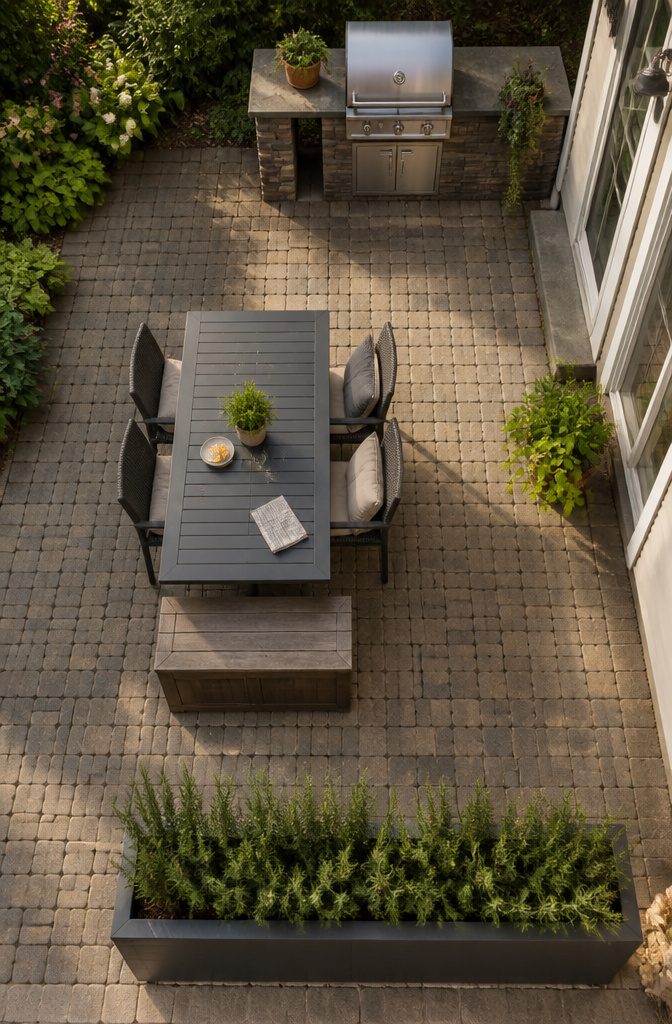
Seats facing each other, no more than 8 feet apart, is the rule that makes a patio table feel like a dinner party instead of a row of strangers.
Measure that before you buy a table, because a long one pushes the far ends out of easy conversation.
Zones keep the whole thing from turning into a traffic jam.
Put dining, cooking, and walking paths on separate parts of the plan, and sketch the route a person takes from the door to the grill with a plate in hand.
On a small patio, I’d skip a built-in kitchen and pick multifunctional pieces, like a bench with storage, keeping the pathways open.
A larger patio can carry a grill island, modular cabinetry, and an L-shaped layout, with the cook’s zone at one end and the table at the other.
8. Lighting for Evenings
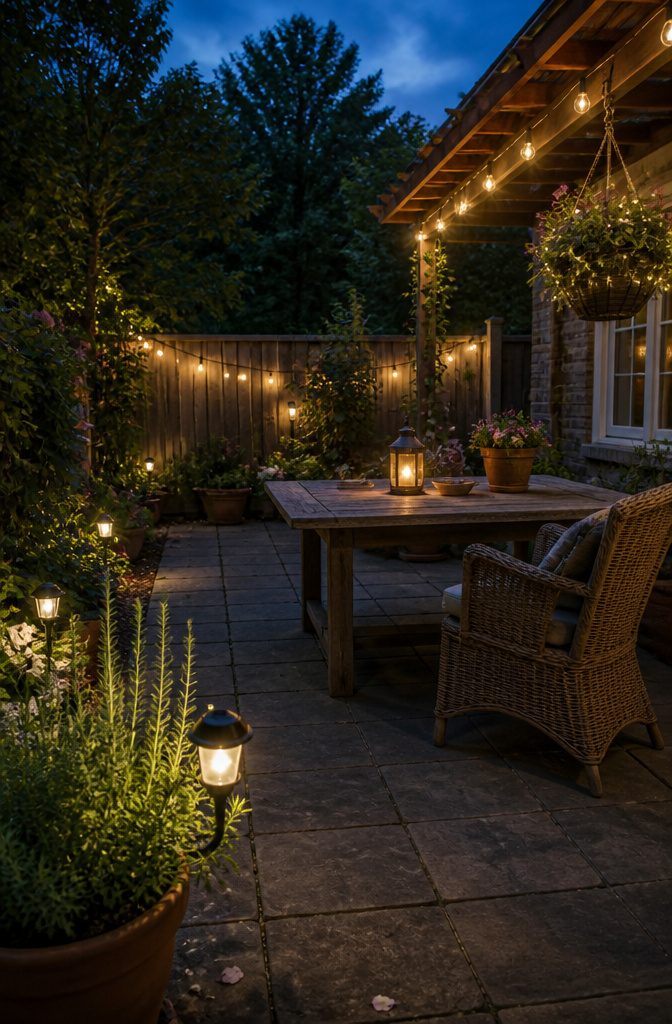
Layering beats any single fixture. Start with ambient light, such as string lights looped along a fence, railing, or the edge of a pergola, then add small accents like lanterns on the table and pot lights tucked among the planters.
String lights also carry a cottage or boho look without extra decor, which is why I reach for them first.
Renters should buy solar lamps and battery-powered LED lights, since nothing needs wiring and everything lifts off when the lease ends.
Solar stakes and lanterns charge by day, but they dim fast in shade, so set them where they get direct sun.
Fairy lights are the lightest touch. Wind them through a hanging basket or a vine and the glow reads as soft rather than bright.
9. A Fire Feature Focal Point
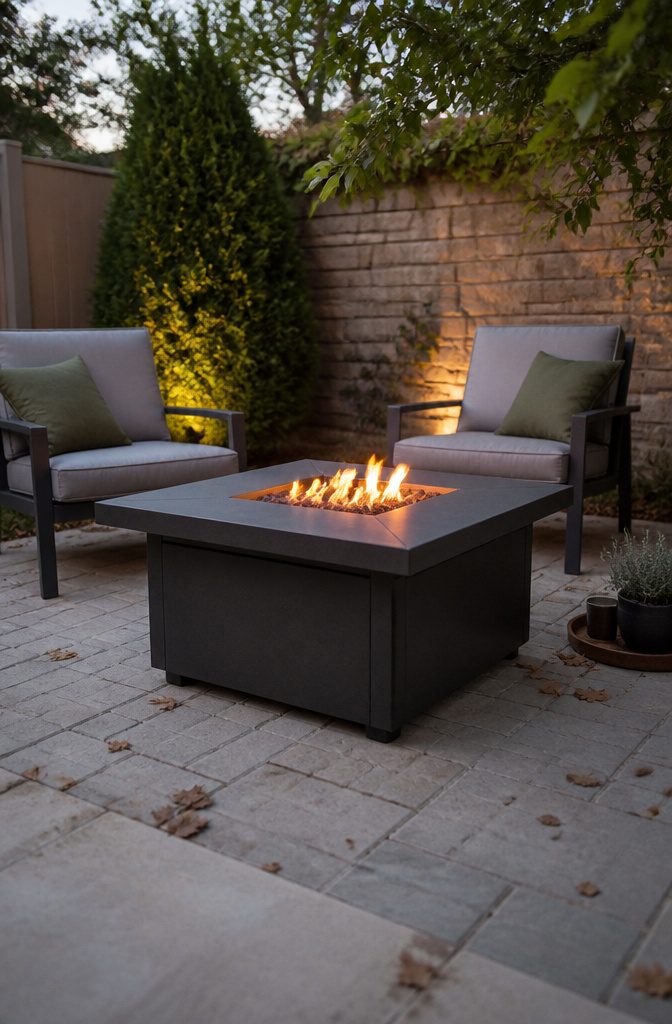
A fire pit pulls a patio together faster than any plant or planter, because people drift toward it and the seating arranges itself around the flames.
For a small patio, a propane fire table wins over a wood pit: no smoke in your neighbor’s window, no sparks, and the tabletop doubles as a place to set drinks.
Clearance is the rule to take seriously. Check the manufacturer’s manual for the required distance to walls, fences, railings, and overhead branches, and keep chairs and cushions outside the heat zone.
Never use a fire feature under a covered roof or pergola unless the product is rated for it.
Set it on level, non-combustible ground such as pavers, stone, or concrete, never on bare deck boards or grass.
Press on each corner before the first lighting; a wobble means shimming or re-leveling. Renters should check lease and local fire rules first.
10. A Water Feature
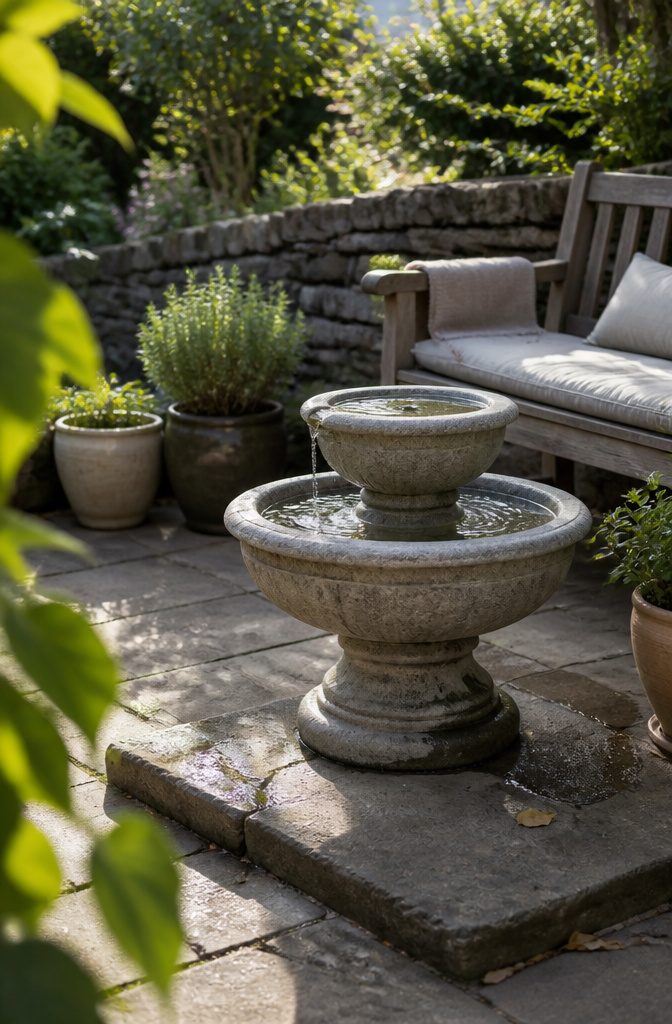
A small fountain does two jobs at once: it gives the eye something to land on, and it gives the ear something to follow.
The sound of moving water has a soothing effect on the brain, and I think that matters more than the look. A steady trickle can pull attention away from the hum of nearby traffic or a neighbor’s yard.
For a patio, I’d pick a self-contained tabletop or freestanding fountain over a built-in pool.
It sets up in an afternoon, it moves with you if you rent, and it needs no digging. Choose the style to match your furniture and pots: sleek stone for modern spaces, a tiered bowl for cottage looks.
Place it near where you sit, so the sound reaches you, not the fence.
11. Patio Materials Compared
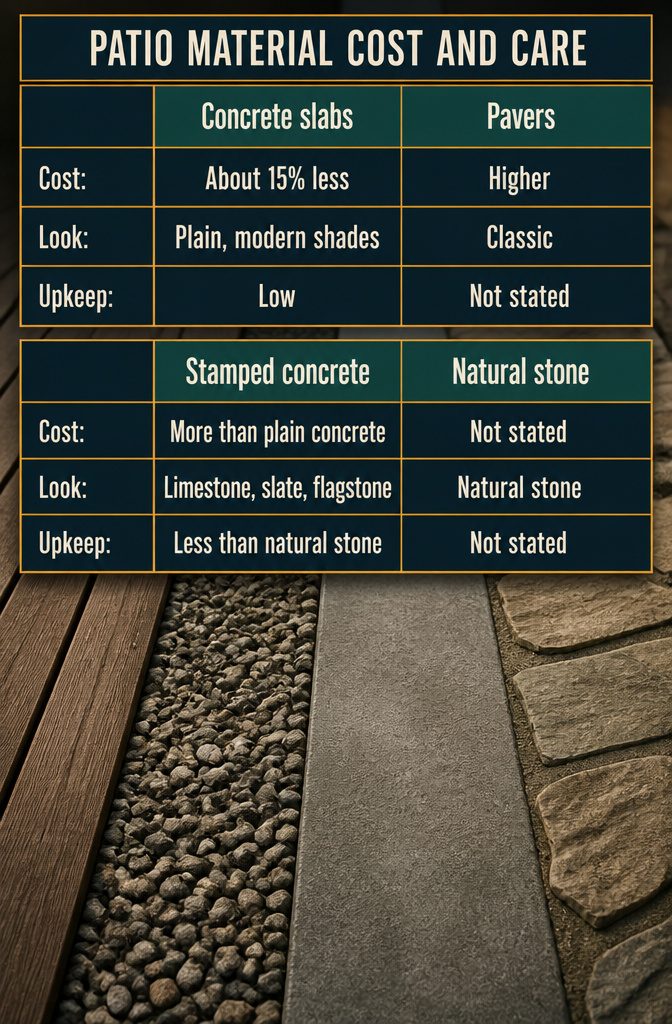
Concrete slabs cost about 15% less than pavers, and that gap is why I start most budget patios there.
Stamped concrete costs more but can be made to look like limestone, slate, or flagstone, and it typically needs less upkeep than natural stone.
Concrete slabs cost about 15% less than laying pavers.
On a tight budget, wood, gravel, and basic pavers are the cheapest ways to get a floor down. Around a pool or water feature, check slip resistance first.
| Material | Look | Upkeep | Cost |
|---|---|---|---|
| Wood, gravel, basic pavers | Warm, loose, or classic | n/a | Budget |
| Concrete | Plain, modern, many shades | Low | About 15% less than pavers |
| Stamped concrete | Mimics limestone, slate, flagstone | Less than natural stone | More than plain concrete |
| Natural stone, travertine, porcelain, ceramic | Polished, upscale | n/a | n/a |
12. Seating for Lounging
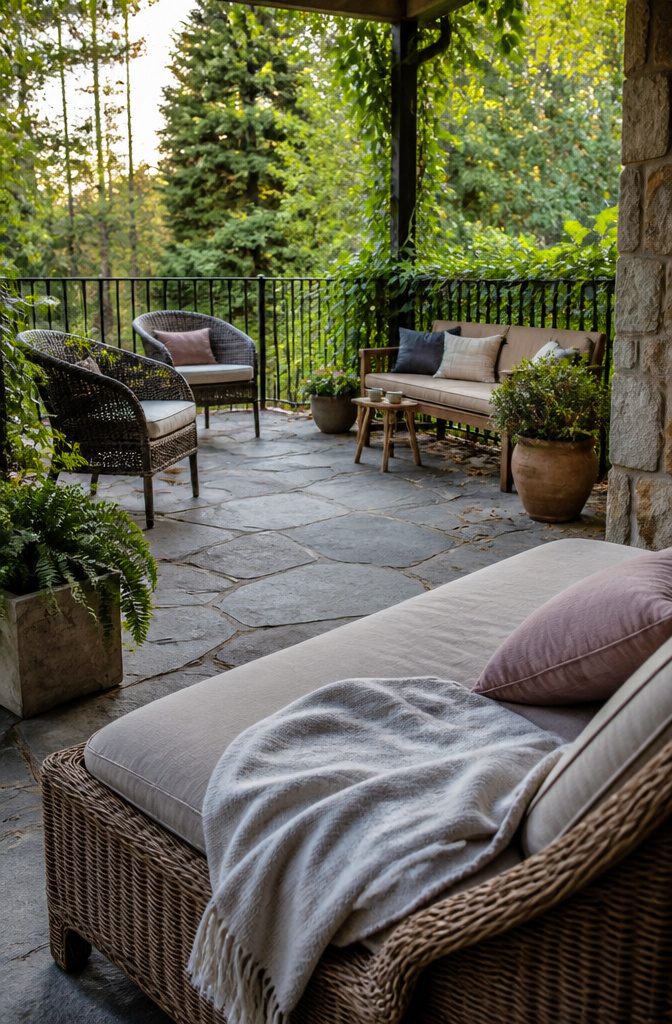
Pick the seat for the job it does most. A lounger or daybed is for lying back, so it needs room to recline and a spot out of the afternoon sun.
A bench with a straight back suits reading and quick coffee, and it tucks against a wall or railing where a bigger piece would block the path.
For talking, keep conversation seats facing each other and no more than 8 feet apart.
Past that distance people start raising their voices or leaning in. On a small patio, two chairs and a bench across from them will beat one long sofa lined up facing the yard.
I’d skip a full set of matching pieces. One daybed plus a bench and a pair of chairs covers more uses, and each costs less to replace.
13. Decorative Style and Color
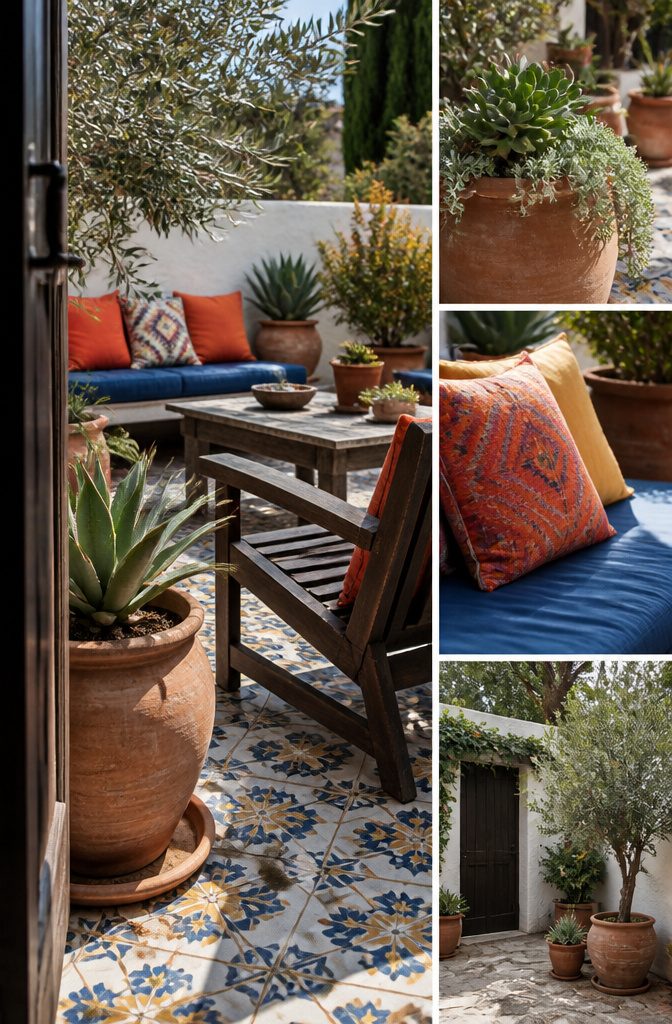
Pick one style and repeat its materials three or four times; a patio with five styles reads as clutter.
- Cottage: white wicker plus overflowing planters gives the soft, romantic look. Skip it if you hate repainting; white shows every smudge.
- Mediterranean: terra-cotta pots and tiles, dark wood, distressed fabrics, and succulents. This is the one I’d pick for a first patio, since the pieces are easy to find and succulents forgive neglect.
- Boho: mix textures and layer plants, with poufs, woven chairs, and low tables. Hanging baskets and vines create a sense of enclosure on an open slab.
- Rustic, coastal, modern: keep each to a tight palette and let the furniture carry it.
- Bold color: clash it on purpose, with loud cushion covers against patterned tiles. Matching sets look dated now, and covers are cheap to swap if you tire of them.
14. Indoor-Outdoor Connection
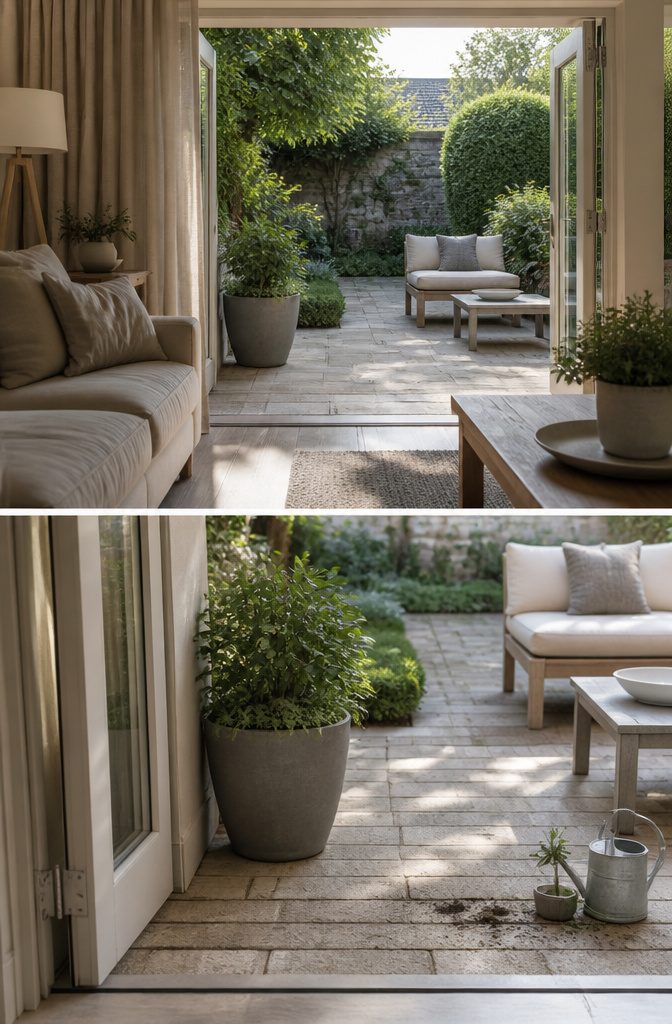
A patio reads as part of the house when it repeats what the nearest indoor room already does.
Look through the back door and note the dominant colors: if the living room is warm gray and cream, outdoor cushions in those tones keep the view from the sofa unbroken.
Outdoor living and dining areas carry the interior style outward, and fabric is the easiest way to do it, since throw pillows and a rug cost far less than new furniture.
Sightlines matter just as much. Line the main path or seating with the door, and put one focal point, such as a planter, a firepit, or a bench, in the view from inside.
Keep the door-side clear so the opening reads as a doorway, not an obstacle course. Matching the door’s trim or frame color on a nearby planter or chair is a cheap way to tie it together.
Plan Around How You Use It
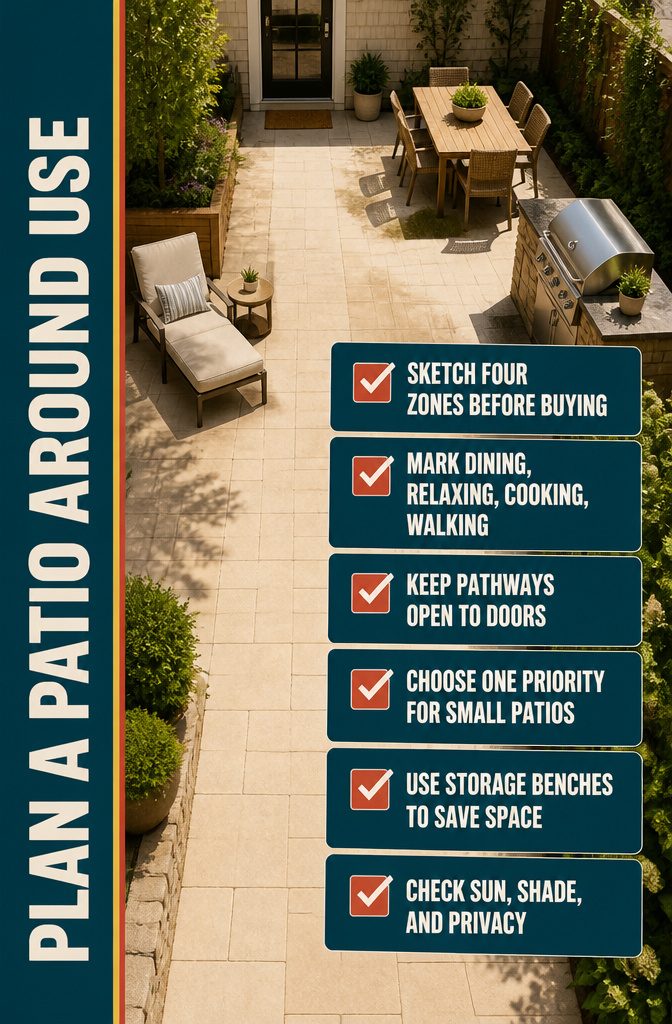
Sketch the patio on paper before buying a single chair, and label four zones: dining, relaxing, cooking, and walking.
The walking zone is the one people forget, and it decides whether the rest works. Keep pathways open so nobody has to squeeze past a grill to reach the door.
On a small patio, pick the one job you care about most.
If you’d rather read with a book than host dinner, buy for that and skip the dining set. Multifunctional pieces, like a bench with storage, earn their floor space.
Larger patios can handle an L-shape, a fire pit, or a separate conversation corner.
Before you commit, watch where the sun and shade fall and where neighbors can see in. Privacy can come from shrubs, trellises, or a screen.
Keeping a Patio Maintained
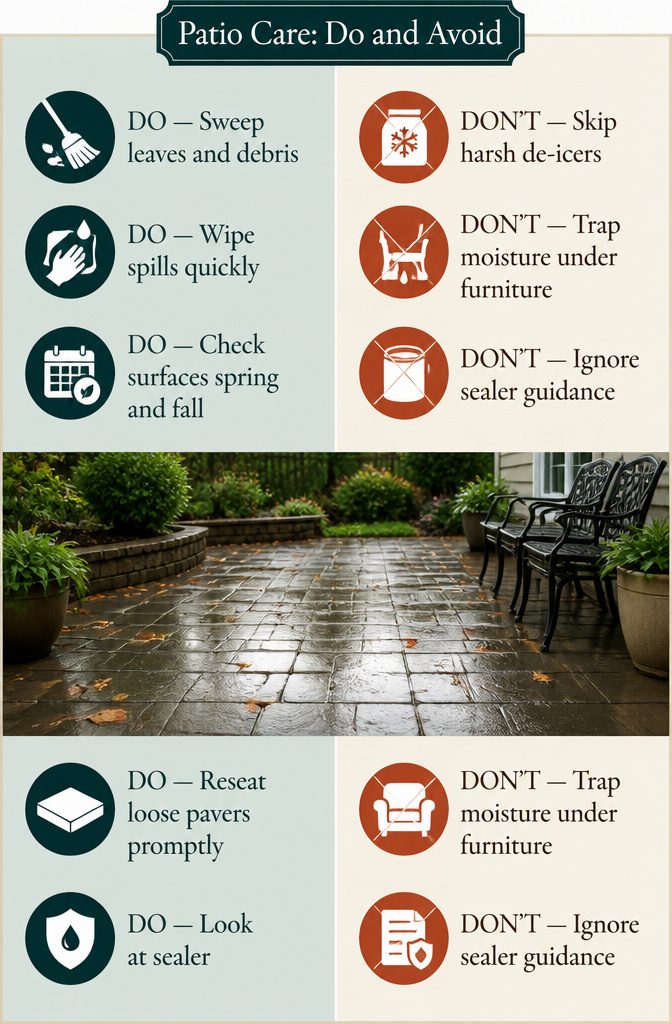
Patios need less upkeep than most people expect, but a few checks keep small problems from becoming repairs. Here is what I would put on the calendar:
- Sweep often and clear leaves and debris, since wet leaves feed algae and leave stains.
- Wipe up spills quickly, before they soak in.
- Check each spring and fall for algae, stains, salt damage, loose pavers, and shifting edges.
- Reseat any loose paver right away; one rocking stone tends to pull its neighbors with it.
- Look at sealer. Some surfaces benefit from it, so follow the manufacturer’s recommendation for yours.
- Before winter, move furniture that could trap moisture against the surface.
- Skip harsh de-icing products, which can damage the patio floor and cause the salt damage you are checking for.
- Concrete is low-maintenance, and stamped concrete asks for less care than natural stone.
Frequently Asked Questions
What is the best patio design on a budget?
Keep it simple: a floor of wood, gravel, or basic pavers, with essentials first (stable surface, comfortable seating, shade, and lighting).
Add DIY touches like string lights and planters over time. Concrete slabs are another budget route, costing about 15% less than pavers.
What is the cheapest patio to build?
Wood, gravel, and basic pavers are the cheapest ways to get a floor down.
Plain concrete slabs also run about 15% less than laying pavers, which is why they make a good starting point for a tight budget. Stamped concrete costs more than plain concrete.
How do I design a patio garden?
Pick the planting style that fits your space: pots, raised beds along the edge, or vertical trellises and planters.
Check how much sun reaches the patio before you commit, since light limits what will grow. On a small patio, go up with tiered or vertical planters instead of using floor space.
How do I make my patio look nice?
Choose one style and repeat its materials 3 or 4 times, because mixing 5 styles reads as clutter.
Layer in lighting such as string lights and lanterns, and add planters in varied sizes. Repeating the colors of the nearest indoor room in cushions and a rug ties the patio to the house.
What type of patio is easiest to maintain?
Concrete is low-maintenance. Stamped concrete, which can mimic limestone, slate, or flagstone, typically needs less upkeep than natural stone.
How do I maintain a patio?
Sweep often and wipe up spills quickly, then check each spring and fall for algae, stains, salt damage, loose pavers, and shifting edges.
Reseat a loose paver right away so it doesn’t pull its neighbors out of place. Skip harsh de-icing products, and follow the manufacturer’s advice on sealer for your surface.