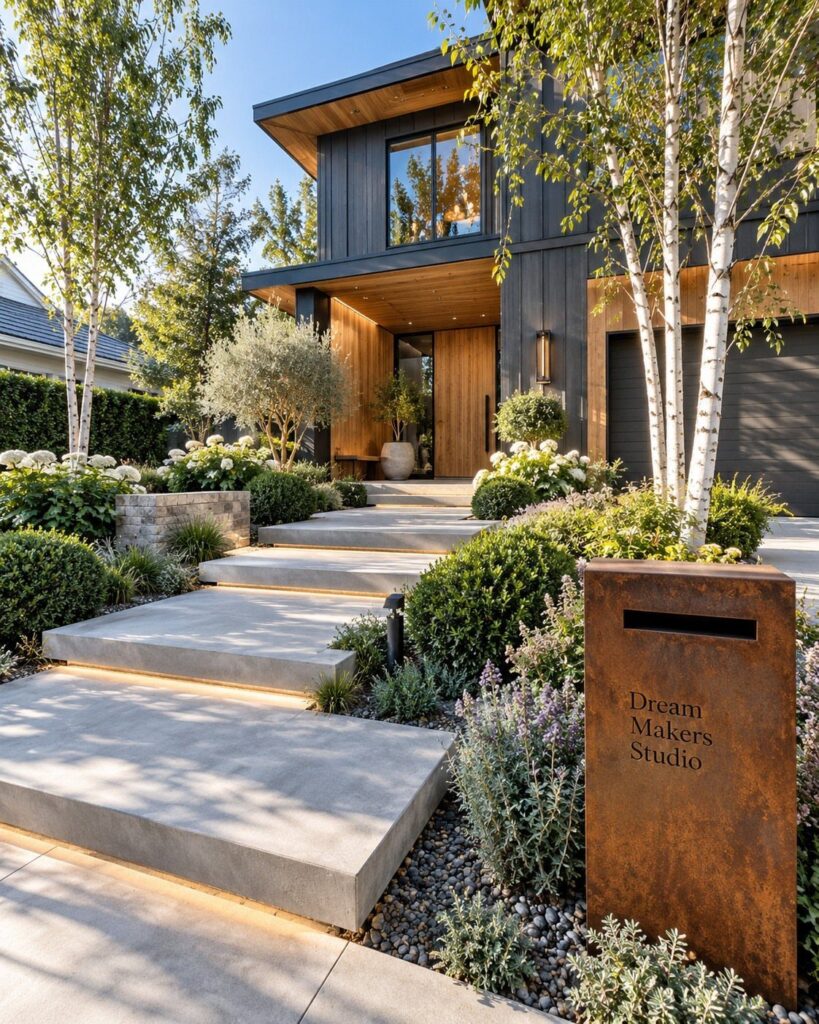
These ideas run from a no-wiring solar stake light or a single window box to a stone fountain that I’d budget for before anything else, and from a clipped lavender allée to a loose bed of ornamental grasses.
What picks yours is the yard you already have: how much sun it gets, where rain pools, what the house looks like and what climate you garden in.
A dry-climate yard with gray-green succulents and river rock asks for very different choices than a green lawn with a curved brick walk.
1. Art and Plantings
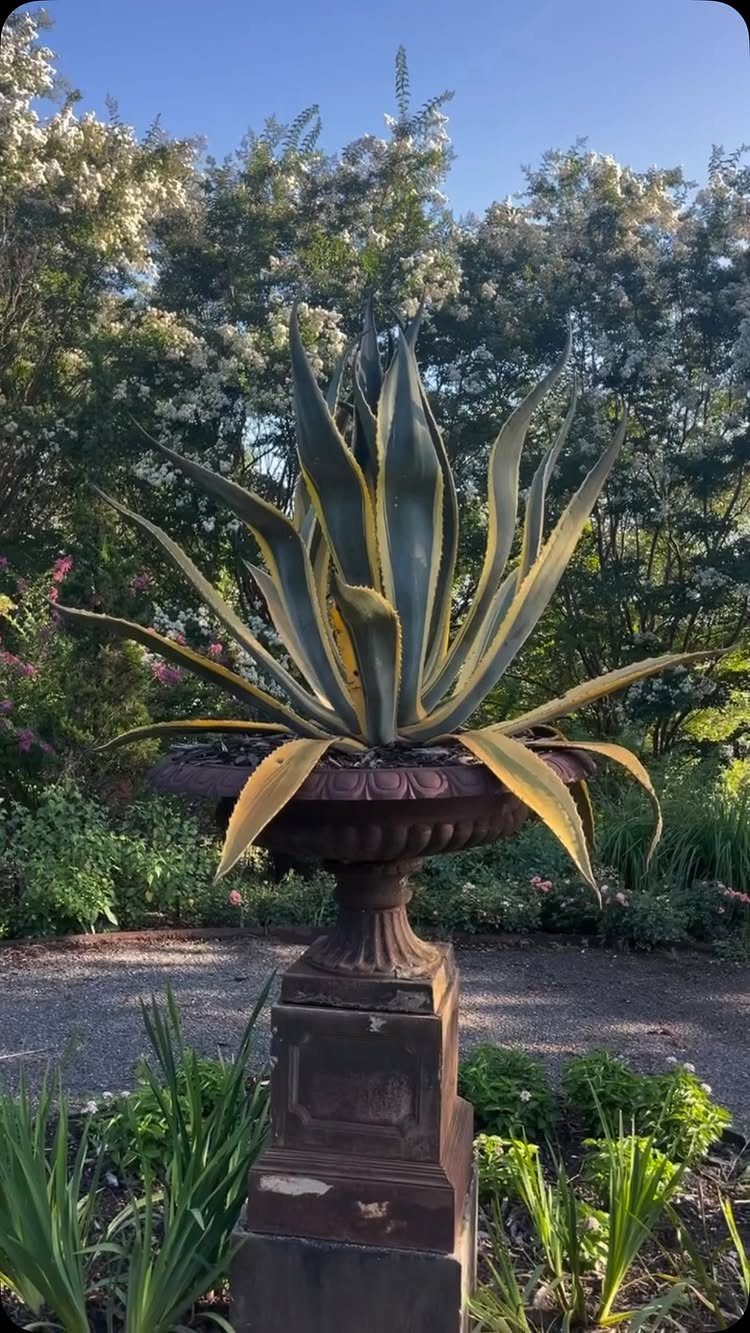
A single large agave in a stone urn does the work of a sculpture, and that’s the move I’d copy.
Pick one strong plant with a bold, architectural shape, then give it a pedestal or a classical container so it reads as an object, not just a pot.
Set it where the eye already travels, at the bend of a gravel path or against softer flowering shrubs.
The contrast between spiky leaves and loose blooms makes the piece look intentional. Keep the surrounding planting quieter so the urn stays the star.
2. Planters and Raised Beds
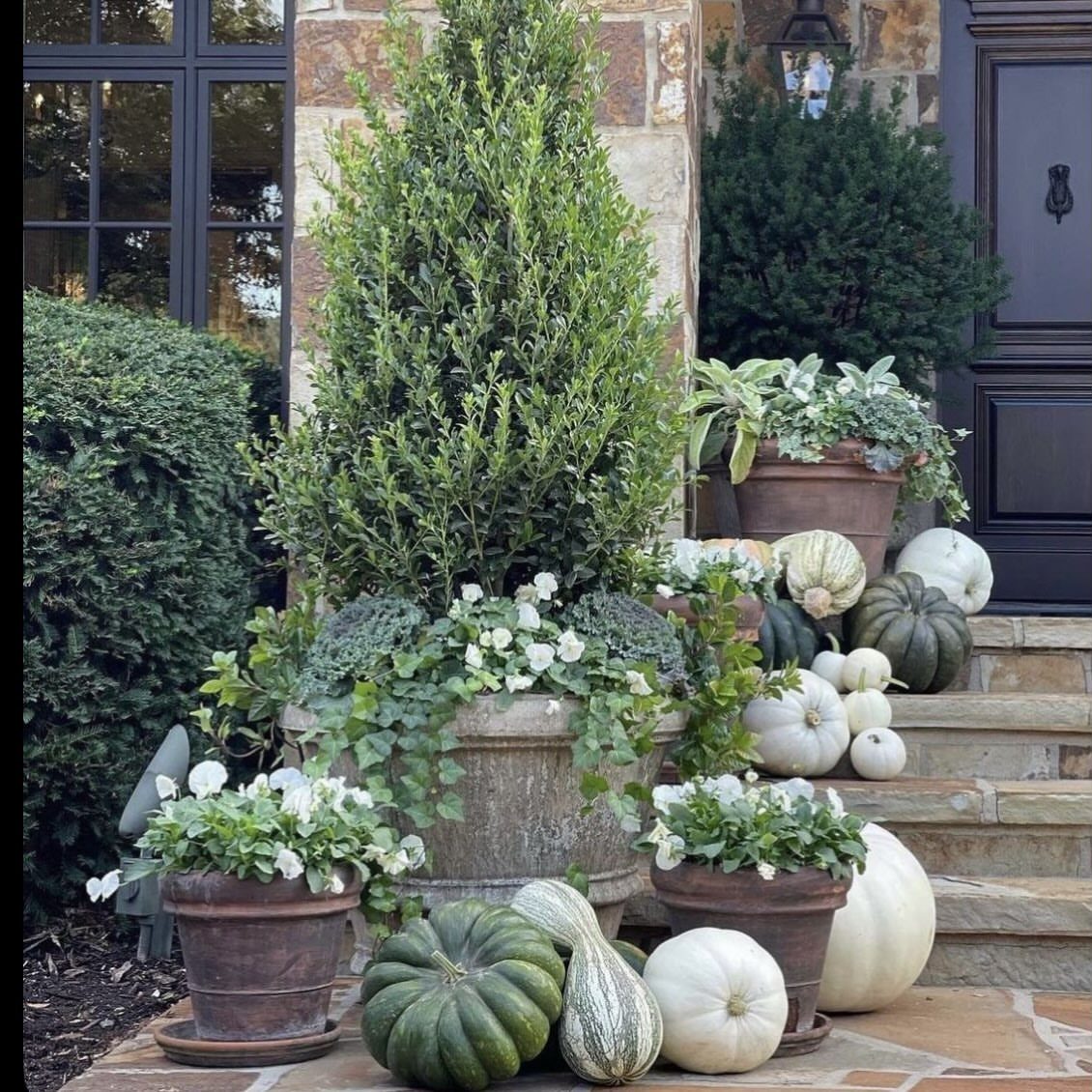
Pots and raised beds give a front yard edges, and edges make a yard look planned.
Terracotta and stone containers in mixed sizes, grouped on porch steps, let you build height with one tall shrub in back and lower white flowers and greenery in front.
I like grouping in odd numbers and repeating a material or two so the cluster feels collected, not scattered. Containers also keep the work small: you water and trim a handful of spots instead of a whole bed.
Seasonal extras like pumpkins, mums or a few ornamental gourds can swap in and out around the plants, so the bed looks fresh each fall without any replanting.
3. Landscape Lighting
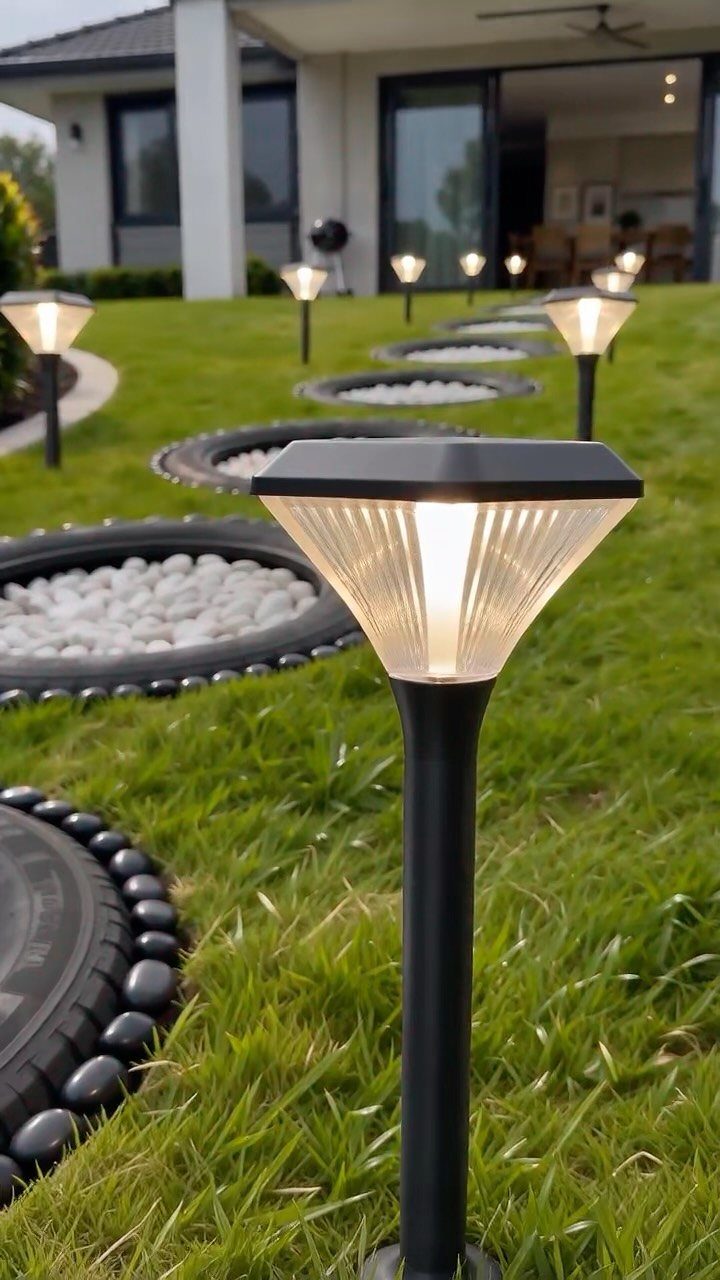
Solar stake lights are the cheapest way to make a front path usable after dark, since there’s no wiring and no electrician.
Black fixtures spaced along the edge of a path or bed give a steady line of light that guides footsteps and shows off the white stone nearby.
Place them where the panel gets full sun, or they’ll dim early in the evening. Spacing them evenly looks cleaner than clustering them.
Expect softer light than a wired system. For marking a route, that’s usually plenty.
4. Modern Minimalist
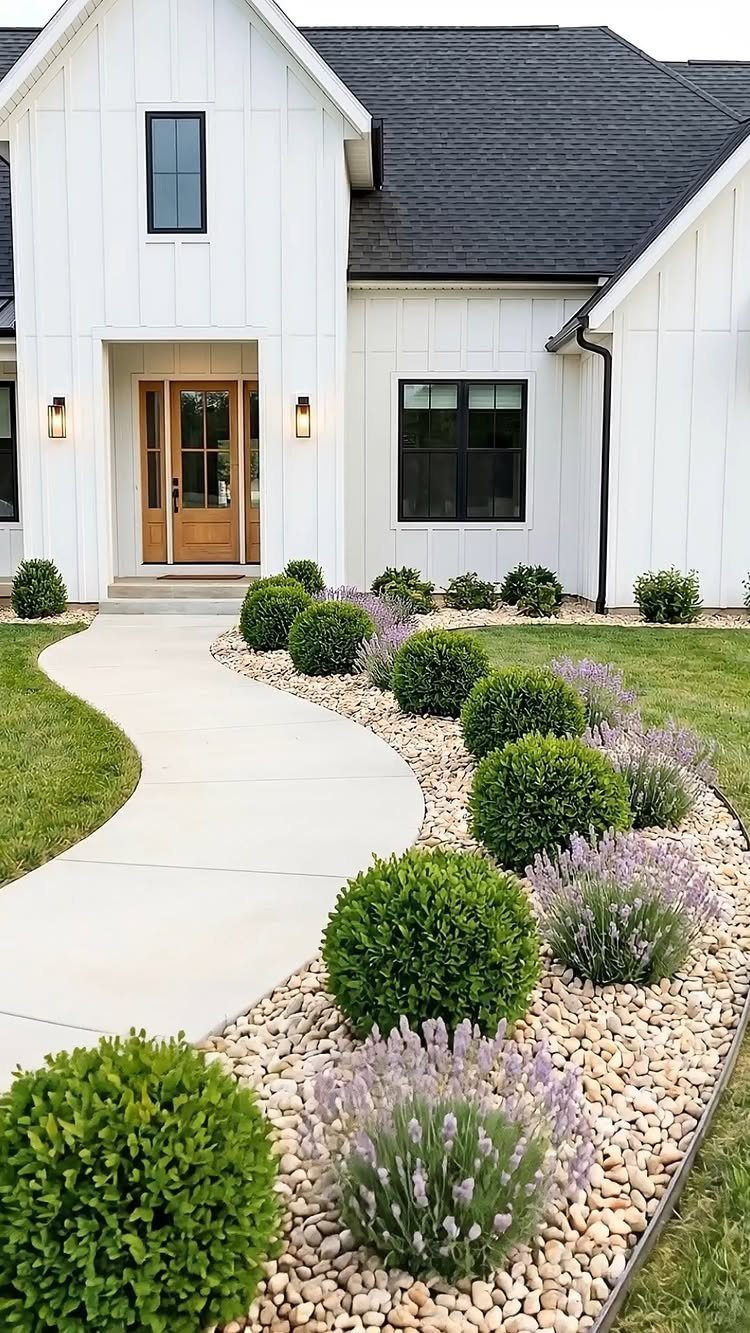
Curves can be minimal too. A sweeping concrete walkway, a few rounded shrubs, and one purple accent like lavender keep the palette tight, so the house stays the focus.
I’d limit the plant list to two or three types and repeat them. Light river rock between plantings keeps the ground tidy and echoes the pale siding, which is what makes the look feel calm instead of bare.
Restraint is the whole method here: every extra plant weakens the clean lines. Choose a strong walkway shape first and let the planting follow it.
5. Artificial Turf
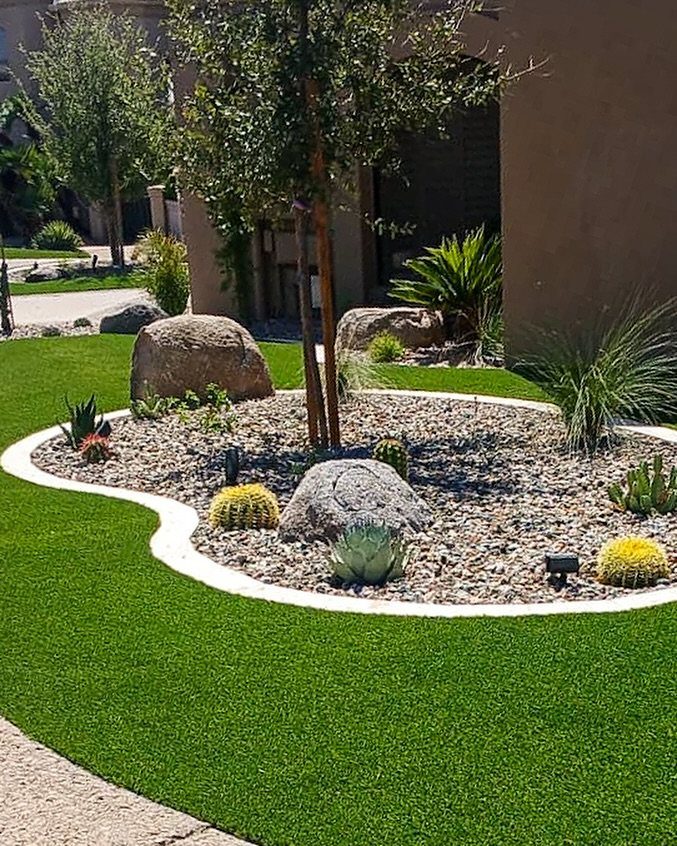
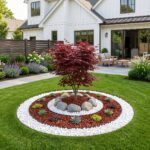
Turf here acts as a green frame around a desert rock garden, and the curved edge is what makes it feel designed instead of like a carpet.
Cacti, succulents, and boulders sit in the center, so the turf only has to cover the ground around them.
A crisp border, like the white one visible, keeps the line between turf and rock sharp. Make the curve generous, since tight bends are harder to fit neatly.
It’s a good pairing for dry-climate yards: the plants stay low-water, and the turf gives a constant green without mowing.
6. Front-Yard Seating Area
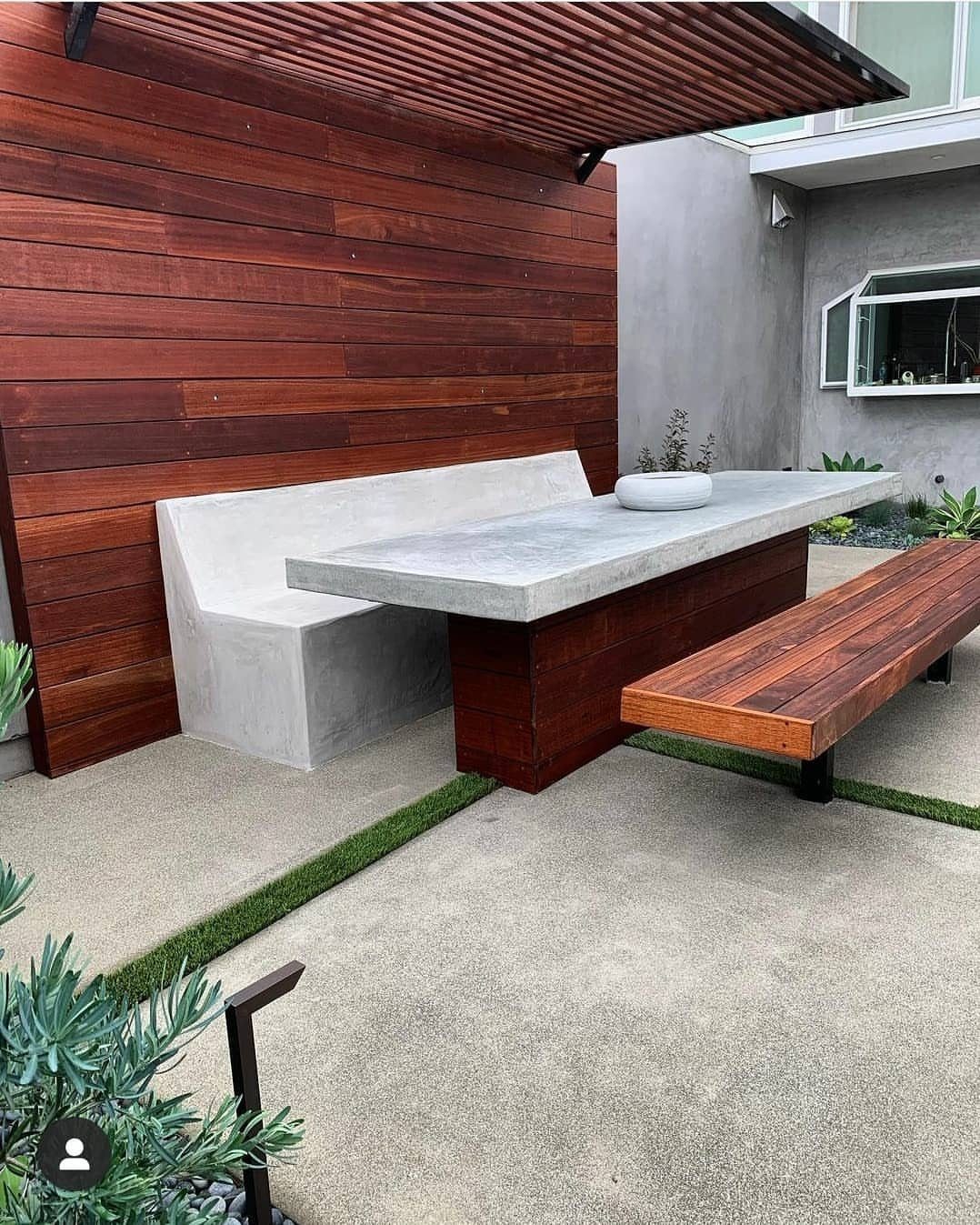
A front yard doesn’t have to be all planting. Concrete benches, a built-in table, and a wooden slat wall turn a hard-surfaced yard into a small outdoor room, and the slats add warmth against all that gray.
I’d treat the slat wall as the key choice: it gives privacy from the street while still letting air through. A pergola overhead defines the space so it feels like a room.
Even with minimal greenery, a few pots would soften the edges. Built-in seating also means no furniture to haul in or out.
7. Landscape Borders
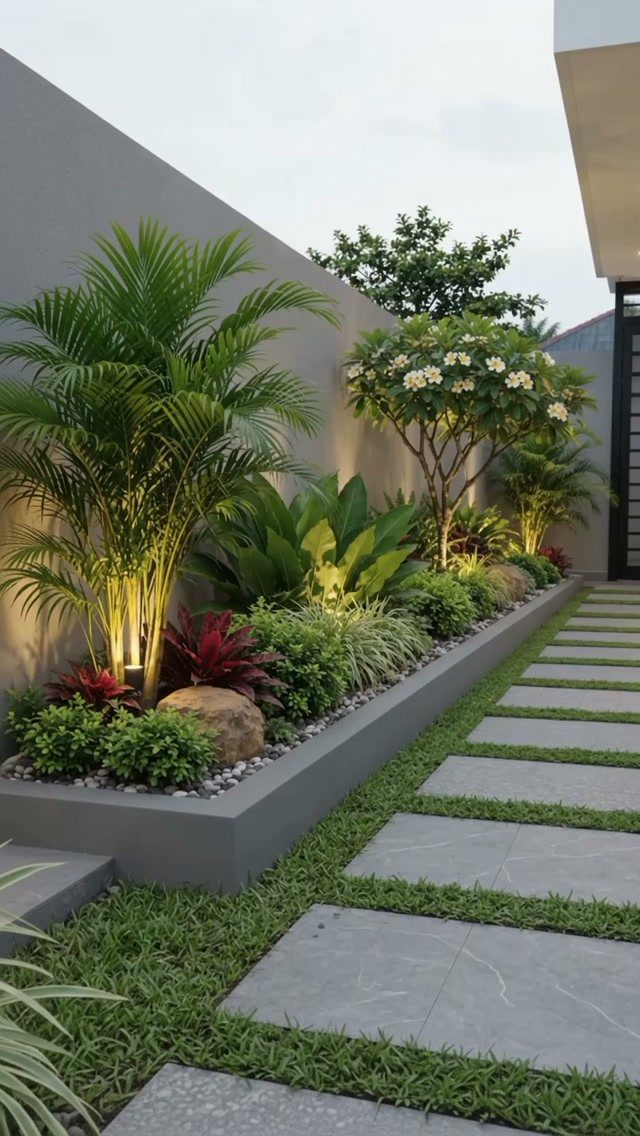
A concrete edge is the cleanest way to give a bed a hard outline.
I’d run the border alongside the walkway so the bed and the path read as one design. Matching the edge color to the wall does the connecting for you.
Defined beds also make the yard easier to keep up, since the line shows exactly where planting stops and walking starts.
8. River Rock in Beds
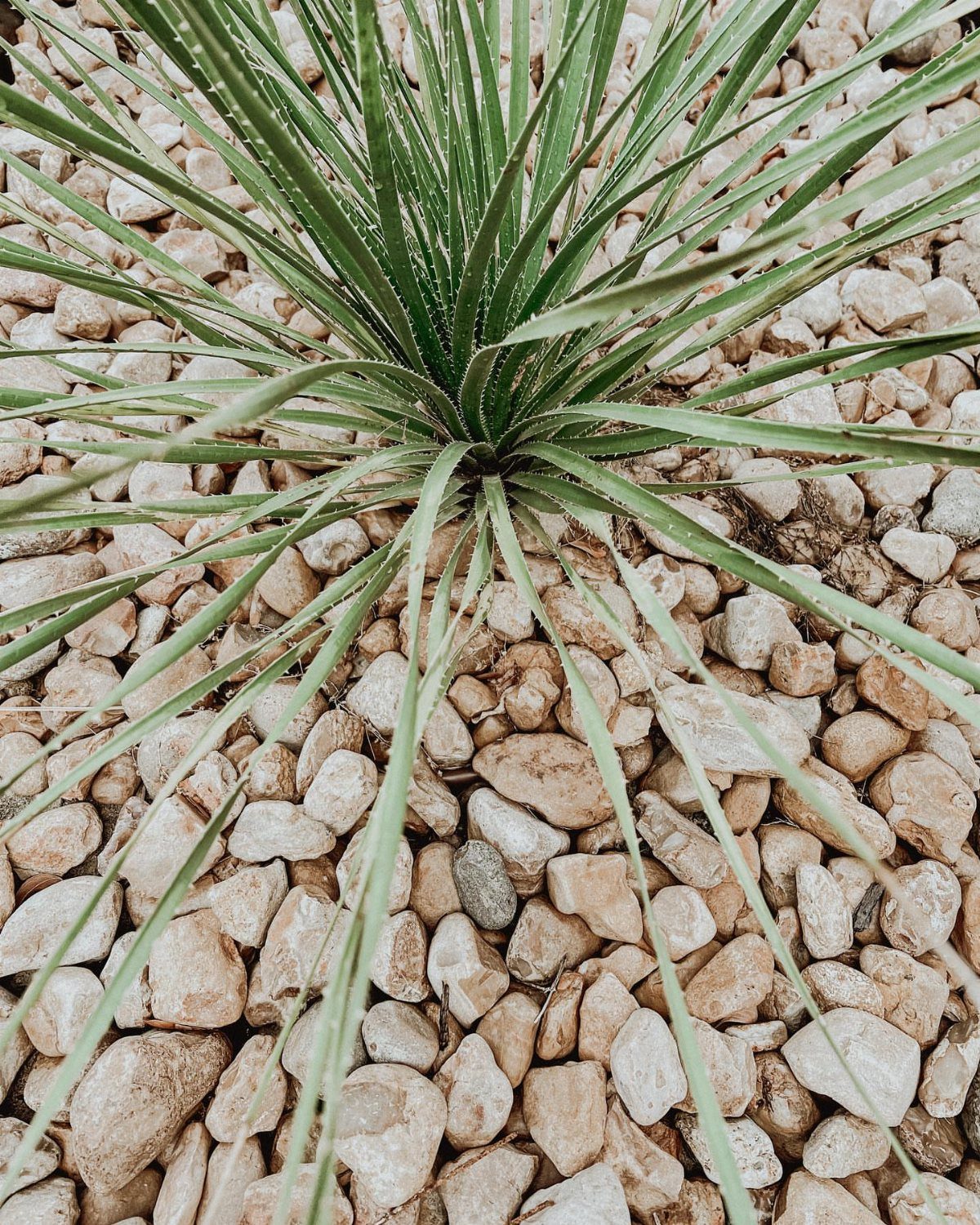
Light plants and loose mulch tend to wander in wind, and river rock stays put. Smooth tan stones around a single spiky plant give a bed a tidy, finished look with no bark to blow away.
I like one bold plant in the center of a bed like this. The rock acts as the frame, so the shape of the plant carries the whole design.
Rock also holds a calm, even color around the plant. Keep the stones one tone, since mixed colors look busy next to a sculptural leaf.
9. Walkway Design
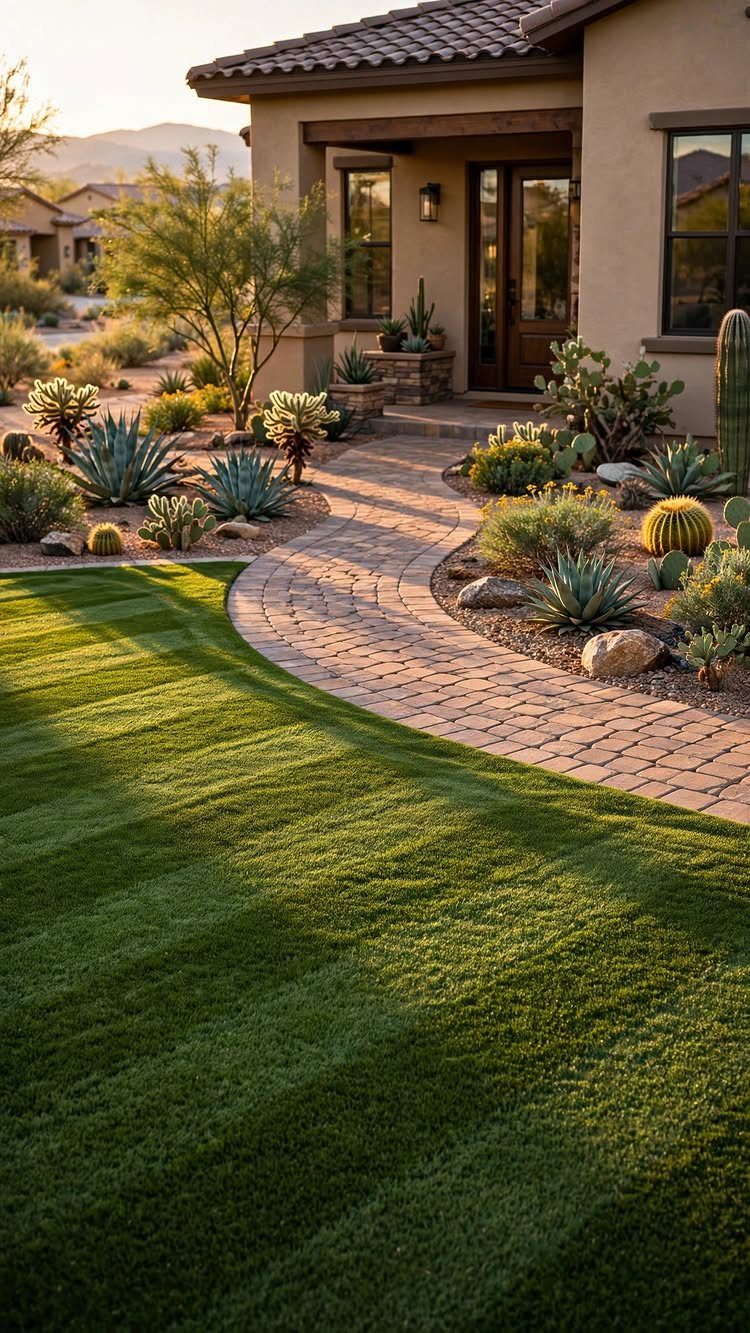
A curved brick walk slows the approach and makes the front door feel like a destination. The bend also lets you plant on both sides, so a green lawn and a desert bed can share one path without competing.
I’d choose a gentle, wide curve over a sharp one; it looks natural and is easier to lay in brick. Let the path lead straight to the door, with no dead ends.
Brick brings warmth against green lawn and gray-green succulents, which is why I prefer it to plain concrete here.
10. Ornamental Grasses
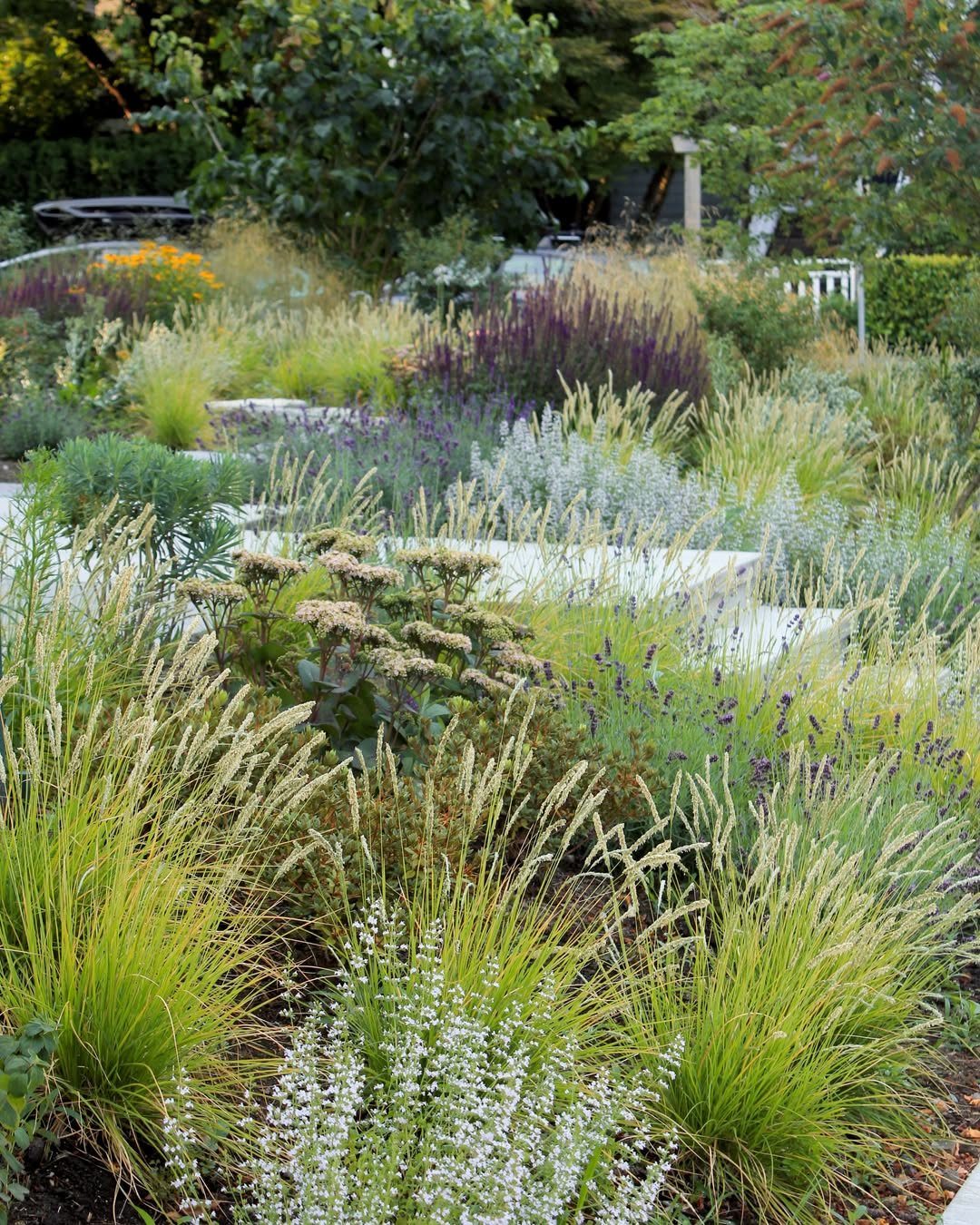
Grasses add the one thing flowers can’t: movement. Planted in tiers, tall at the back and shorter toward the steps, they soften stone and move with every breeze.
I’d mix a few grass types for texture, then add purple lavender and white blooms for contrast. The fine blades make the flowers look brighter.
Use them along a border, beside steps, or as a single accent clump. Repeating one grass in several spots across the bed ties the whole planting together.
11. Native and Drought-Tolerant Plants
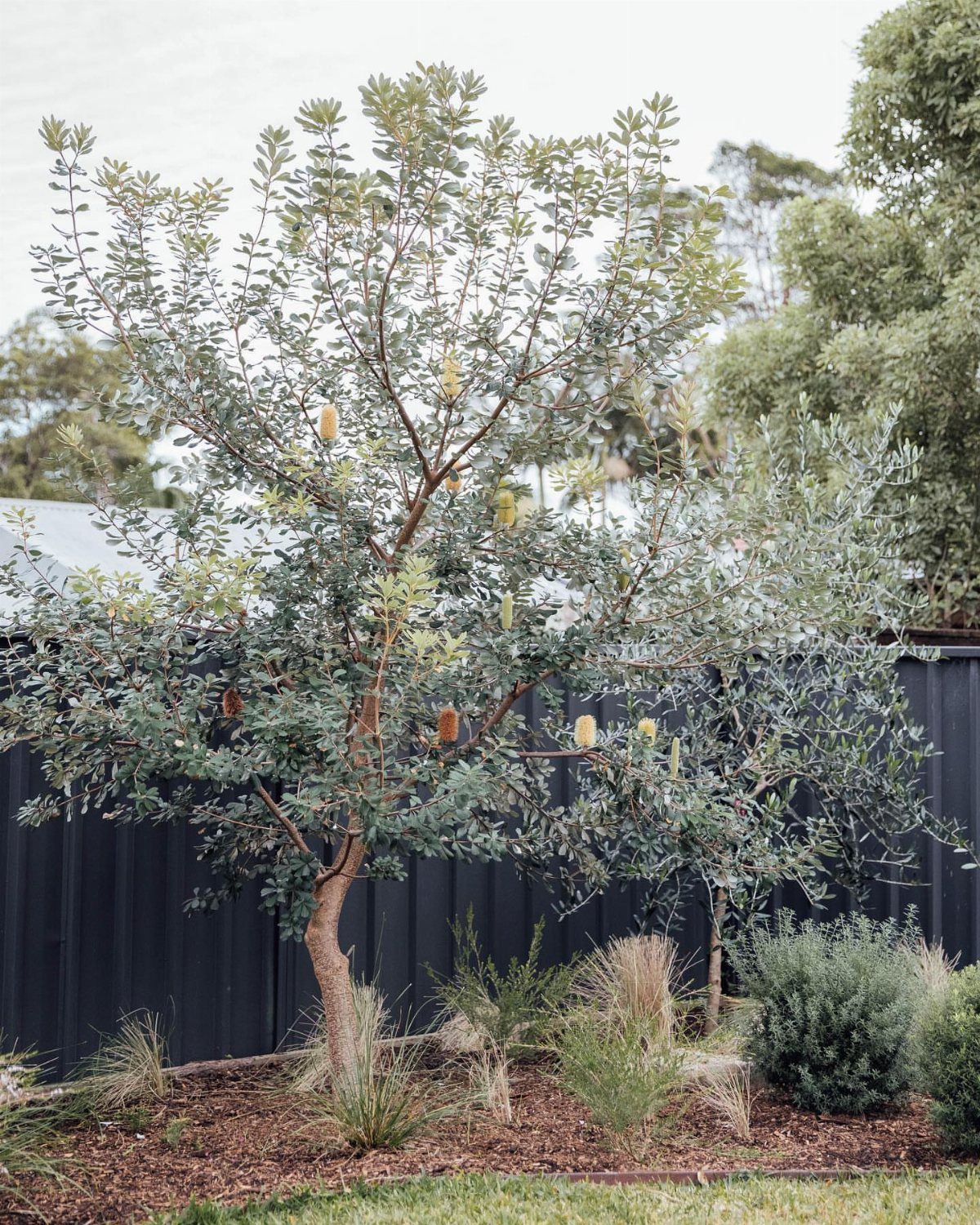
A small native tree with silver-green leaves makes a smart anchor for a low-water yard. Pair it with ornamental grasses and you get a planting that suits the local climate, so it needs less watering and less fuss.
Mulch the bed around the roots, and let the planting stay simple against a plain fence. The fence acts as a dark backdrop that makes the pale foliage stand out.
Check what grows well in your area before you buy.
12. Water Feature
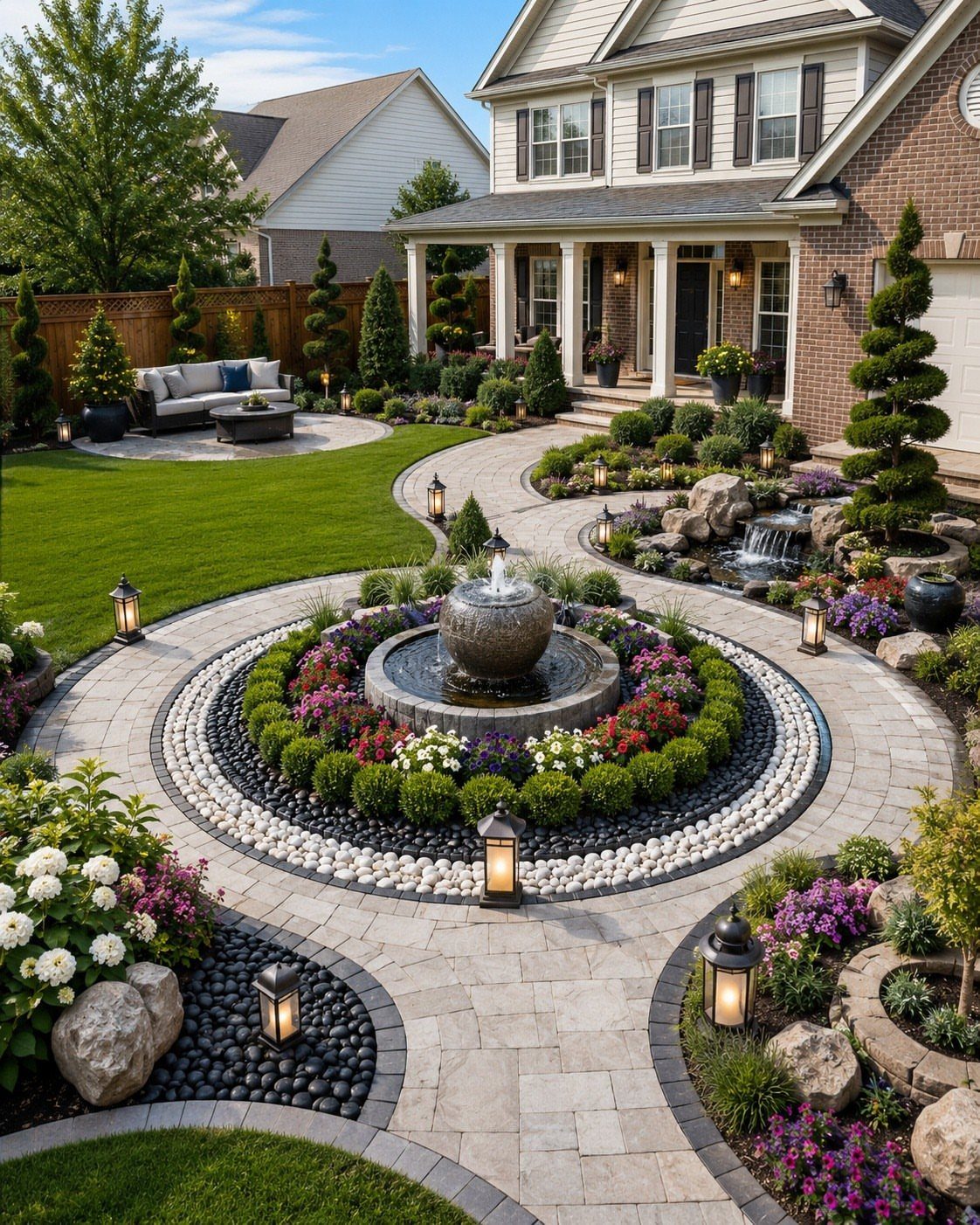
A round stone fountain gives a front yard a center, and a small waterfall adds the sound of running water to drown out street noise. Rings of pebbles around the base make the circle read clearly.
I’d place it where it’s visible from the walkway, with flower beds close around it so the stone sits in color instead of standing alone.
Think about where the water will run, and how you’ll power the pump, before you buy. A fountain this size is a larger project than a planter, and it’s the one I’d budget for first.
13. Sculptural Succulents
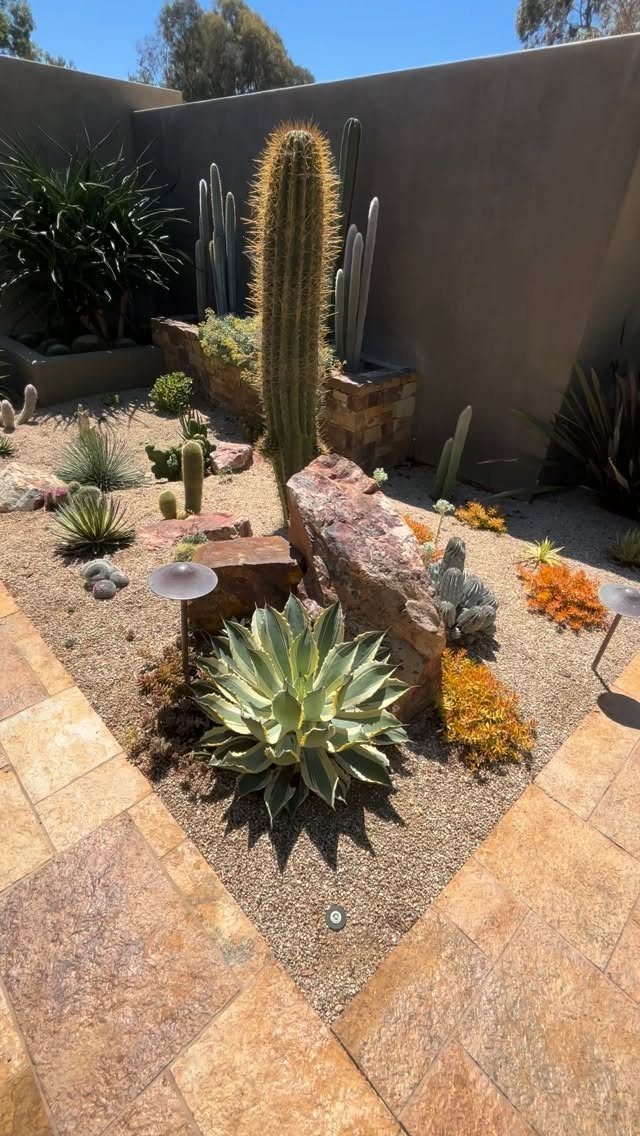
Tall columnar cactus, agave, and low rosettes give a gravel yard 3 layers of height without a single flower.
I’d set the tallest plant off-center and let the large rocks sit between the plants, so the group reads as a landscape instead of a row.
Gravel keeps the ground tidy and fits the stone patio and gray wall. Succulents suit a low-maintenance yard, and the pale ground makes each shape easy to read.
Leave room around each plant. Crowding hides the outlines that make them worth growing.
14. Vertical Vines
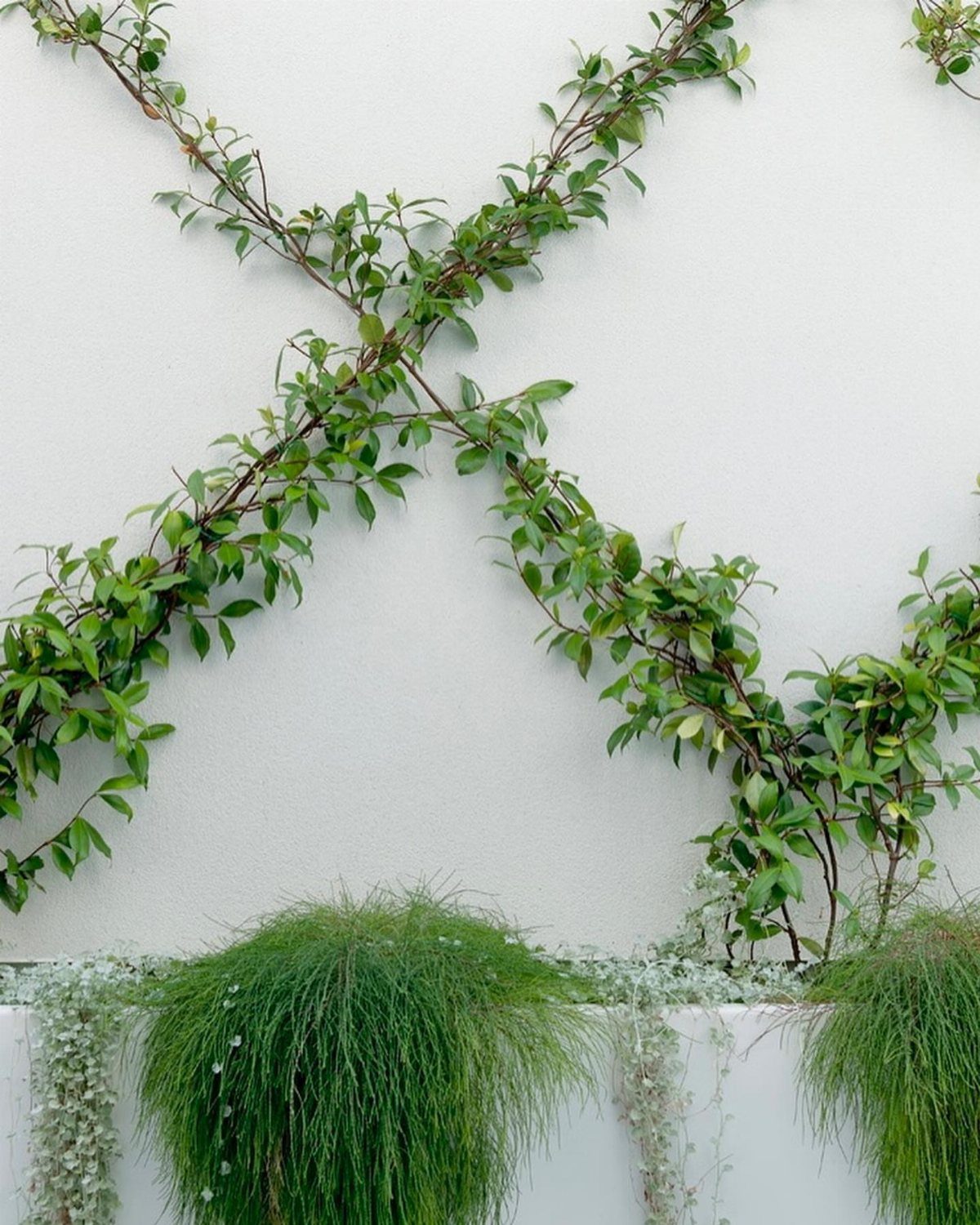
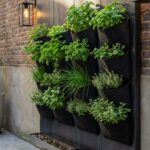
Where a yard has no room for beds, a white wall can hold the planting instead. Vines trained into a diamond pattern turn the wall into a living lattice, and I’d choose that crisp shape over letting them sprawl.
Run the support lines first, then tie the young stems along them as they grow. A planter at the base, filled with ornamental grasses and trailing plants, softens the bottom edge and hides the roots.
Against white paint, green leaves show up clearly, so the pattern stays easy to read.
15. Window Boxes
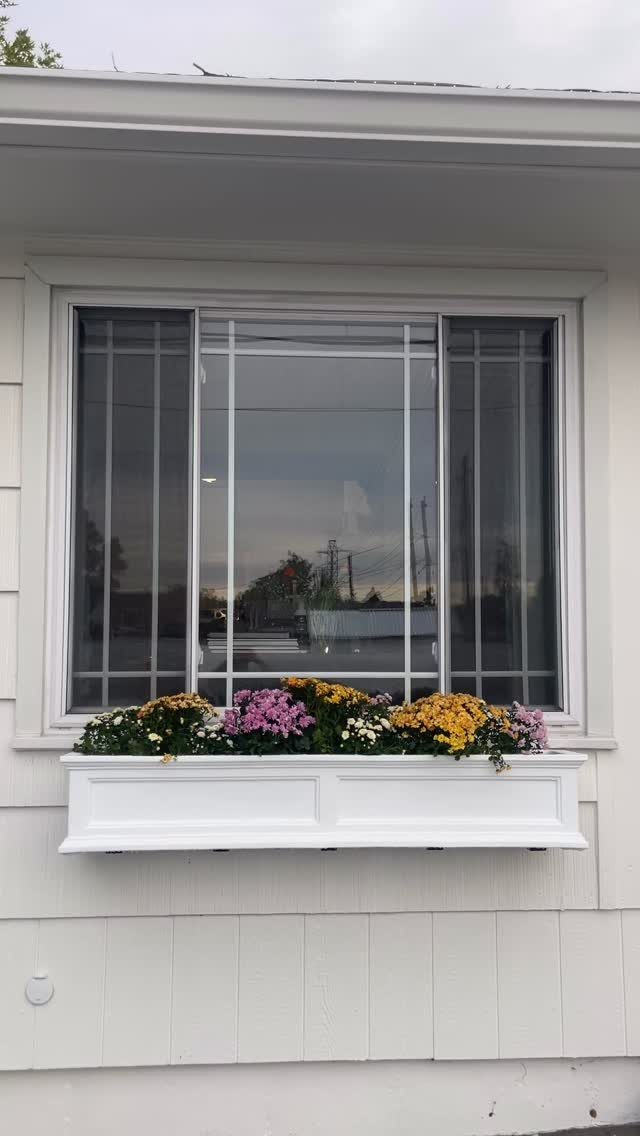
One white window box under a white-trimmed window is a small project with a big return. Yellow, pink, and purple flowers read clearly on a white house, and painting the box to match the trim makes it look built in.
Because the box is small, swapping plants takes minutes, so you can change the colors with the seasons. I’d mix upright blooms with a few that spill over the front edge.
Mount it securely, since wet soil is heavy.
16. House Number Display
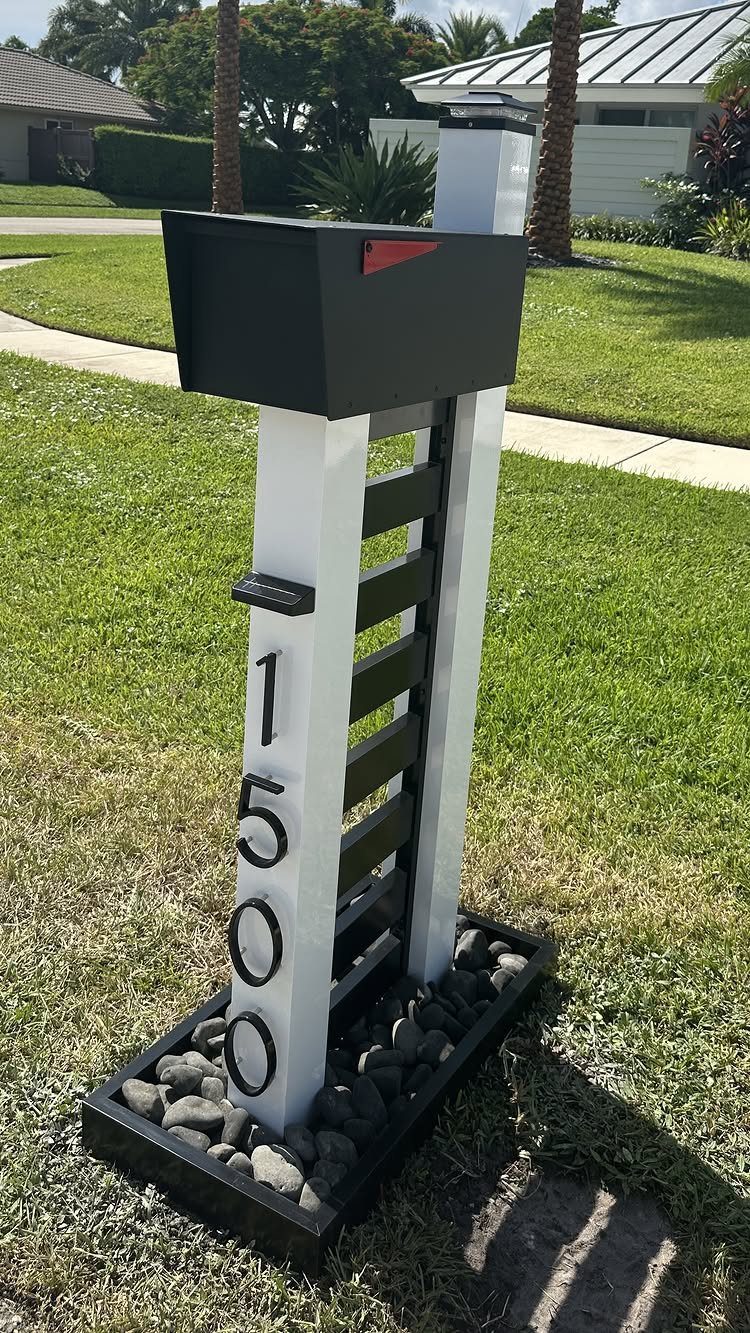
Numbers set vertically on a mailbox post save space and look deliberate. A black and white post, with black numerals against the white, reads clearly from the street, and that legibility is the point of the whole feature.
Against a green lawn, the dark tray gives the post a clean footing.
Pick numerals large enough to read from the curb.
17. Formal Lavender Allées
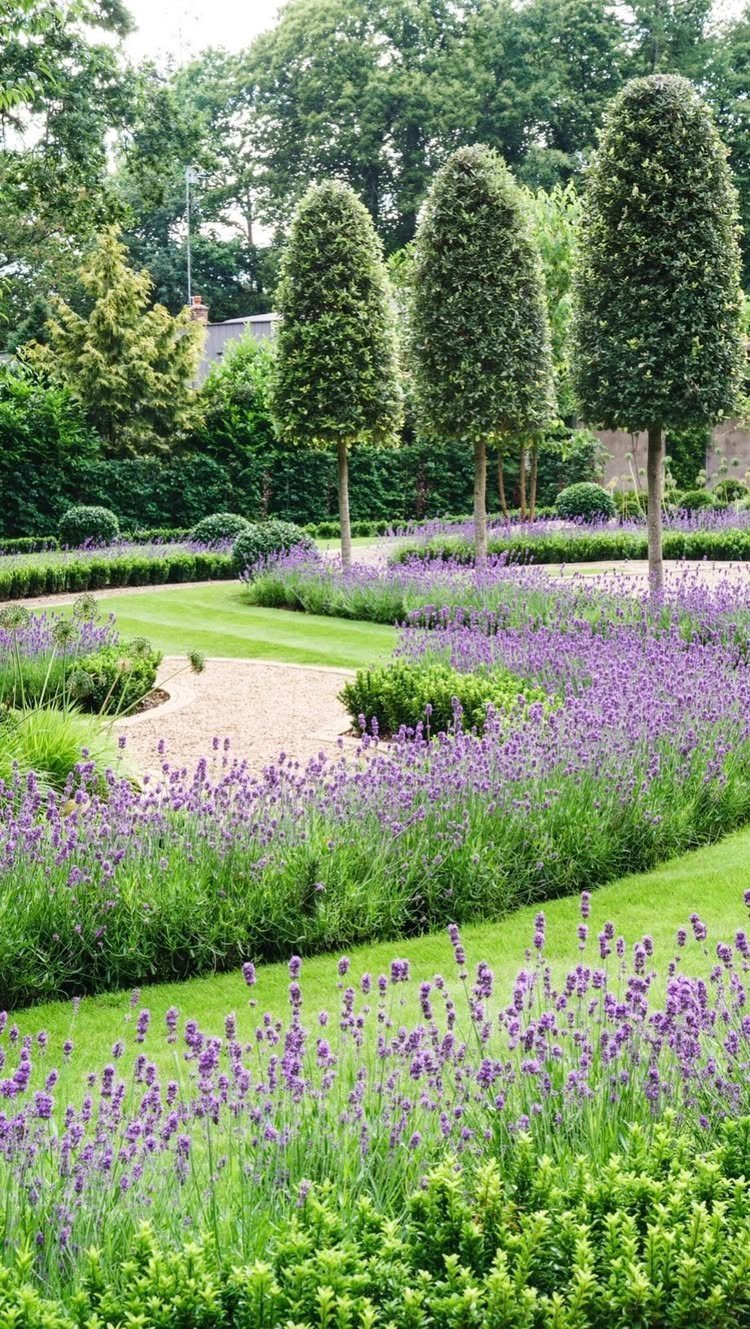
Straight rows of lavender on both sides of a gravel path give a yard formality with very little variety. Three tall conical topiary trees add vertical punctuation, and I’d space them evenly so the symmetry holds.
Keep the rows the same length and width on each side; any mismatch shows right away. Gravel paths pair well with clipped plants because both stay crisp.
This look suits a larger yard best. Clipped trees need regular trimming to hold their shape.
Assess Site Before Planting
Shop for the site before you shop for plants. Most front yards go wrong because people choose by looks first and only later find out the spot is too hot, too wet or too shady.
Check the sun at several times of day, since walls, trees and the house itself cast shade that moves with the hours and the seasons.
Pavement, walls and driveways bounce heat back onto nearby plants, so note those hot edges too.
Then watch the water.
After a rain, mark where it pools and which patches dry out fastest. Those spots tell you where to grade, where to add irrigation, and which plants belong together by water need.
Soil matters as much. Before you buy a single bag of amendment, test the soil: a basic kit or a jar-settling test tells you whether the plot wants compost to loosen heavy clay or gravel to move water away.
Before any of that, sketch the house, windows, utilities, fixed features, property edges and sightlines. Plants and materials go on that map last.
Match Design to Architecture
Look at the house before you pick a style. Its lines, colors and materials already set a language, and the yard should speak it without copying it.
A modern house wants cleaner bed lines, restrained groupings and fewer materials. On a cottage, I’d go with layered beds, soft curving edges and a walk to the door that wanders a little.
In a dry-climate yard with a Mediterranean feel, stone, gravel and strong plant shapes carry the look, so bloom color can take a back seat.
Mixed signals are the common mistake. Pair a formal facade with loose, tumbling plants and the result looks like neglect; pair a relaxed bungalow with sharp geometric beds and it feels stiff, unless something soft breaks up the lines.
Choose one cohesive style first, then let it guide plants, paving and accents.
Watch proportion too. Against a tall house, low shrubs disappear, and on a compact lot a single oversized boulder crowds everything else out.
Plan Maintenance and Timing
Group plants by water need, so one irrigation schedule suits each bed.
Then check each plant’s mature size and space it for that, not for the nursery pot. A sparse young planting looks thin for a while, but crowding costs you more in pruning and replacement later.
Timing depends on climate and the job. Early spring or fall suits most projects.
Spring is good for shrubs, trees and perennials, though wet soil can stall some work. Fall lets roots establish before winter, but few plants are in bloom, so curb appeal comes slowly.
Summer is better for hardscaping like walkways and retaining walls, and it’s hard on new plants and sod.
Winter is for planning, and you can book help for spring. Where the ground freezes, planting waits.
Frequently Asked Questions
How to make a front yard look nicer?
Start by matching the yard to the house: choose one style that fits its lines, colors and materials, then let plants, paving and accents follow it.
Defined edges help a lot, whether from containers, raised beds or a concrete border, because crisp lines make a yard look planned. Repeating a few plant types instead of mixing many keeps the look calm and cohesive.
What are the basic elements of landscape design?
The basics are a site plan, a consistent style, plants, hardscape and accents. Sketch the house, windows, utilities, property edges and sightlines first, then add paths, borders and planting in a style that suits the architecture.
Proportion matters too: low shrubs vanish against a tall house, and one oversized boulder can crowd a small lot.
What are the best low maintenance plants for landscaping?
Native and drought-tolerant plants, ornamental grasses and succulents are the easiest to keep up. Natives suit the local climate, so they need less water and fuss, and succulents in a gravel bed need no flowers or mowing to look good.
Grasses add movement and texture; repeating one type in several spots ties a bed together. Local conditions decide which plants stay easy, so confirm your hardiness zone and soil type at the tag before anything goes in the cart.
What time of year is best to redo your front yard landscaping?
Early spring or fall suits most projects. In spring, shrubs, trees and perennials settle in fast, but soggy soil can hold up digging and planting for a week or two.
Planting in fall gives roots months to grow before the ground freezes; the trade is a bare-looking yard until next year’s blooms.
Hardscape jobs like walkways and retaining walls suit summer’s dry ground, while winter is the time to sketch plans and get on a contractor’s calendar.
How do I make the sides of my house look good?
Choose plants for the light and heat each side gets. A south-facing side gets very hot in summer, so use full-sun plants that handle heat there, and pick shade-tolerant plants for a north-facing side with little sun.